The first thing that catches one’s attention in Kanha is the serene ambience of the forest. Unlike many popular tourist destinations, which are overcrowded and noisy, Kanha has its own quietness that gradually makes visitors get engrossed in the wilderness experience. As we were approaching the forest path in the early morning, we saw mist rising from the meadows, deer standing silently by trees, and bird cries coming from deep within the jungle.
For most tourists visiting Kanha, spotting a tiger becomes the ultimate aim. This thrill of spotting tigers accompanies the visitors throughout their visit to Kanha. However, my Kanha jungle safari trip made me realize that Kanha is much more than tigers. The greenery of the forest, the meadows, the tall sal trees and even the quietness of the jungle cannot be forgotten easily.
If you wish to visit Kanha Jungle for the first time, knowing about Kanha gates and full-day safari booking will be highly useful for you.
How to Understand Kanha Safari Gates?
The Kanha Tiger Reserve situated in Madhya Pradesh is separated into various safari gates and areas. Different gates provide access to different zones with different landscapes and different animal activity.
The misconception among tourists is that all gates provide similar experience, but in reality, it might vary a lot depending on which gate is chosen.
There are open grassland regions where one can easily see animals, as well as other zones which feel more dense and quiet with routes through forests.
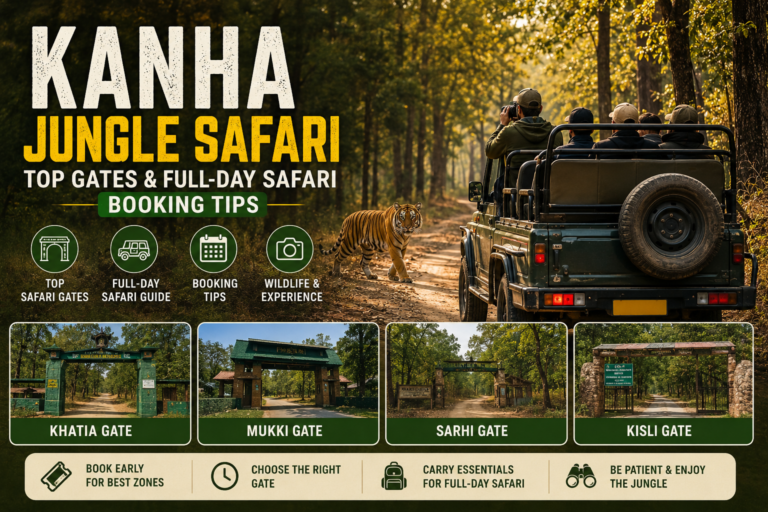
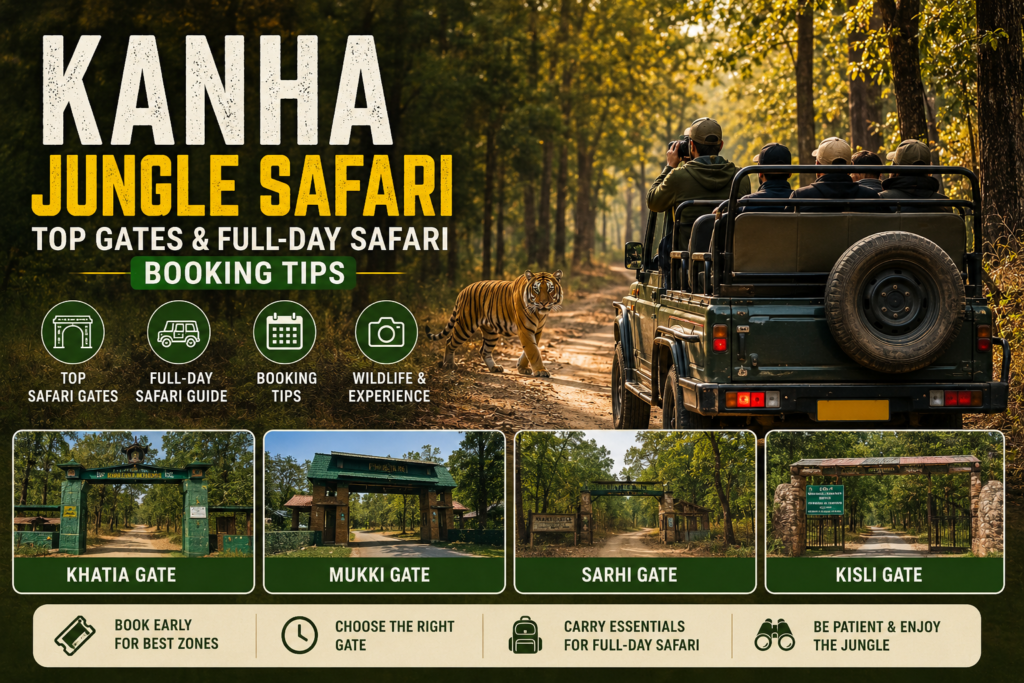
The popular safari gates in Kanha include:
- Khatia gate
- Mukki gate
- Sarhi gate
- Kisli gate
All of them offer their own experience of safari.
Khatia Gate – The Most Popular Gateway
This gate is amongst the most frequently accessed gates in Kanha and is preferred by tourists visiting Kanha from the Khatia tourism region.
My safari at Kanha commenced from Khatia Gate. The atmosphere outside this gate in the early morning was full of excitement as several safaris were lined up silently with guides talking about wildlife movement that occurred in the night.
Once entering inside, the forest would gradually reveal itself to be meadows encircled with sal forests. The forest pathways were smooth and the entire safari seemed to be well-organized.
Khatia gate can be visited by:
- First-time visitors
- Families
- Tourists visiting the primary tourism region of Kanha
Khatia provides opportunities to observe:
- Tigers
- Barasingha or swamp deer
- Spotted deer
- Jackals
- Wild boars
- Langurs
- Various birds
The renowned hard-ground barasingha conservation effort of Kanha is one of the major highlights of this place.
Mukki Gate – Popular among Wildlife Enthusiasts
Mukki Gate appeared to be much wilder and a bit less crowded than Khatia. Many professional wildlife photographers opt for this part of Kanha due to its beautiful forest trails and active wildlife activities.
One particular thing I liked about Mukki was the varied terrain. There were some parts that were dense and shaded, while there were some that opened up into big grassland with great views.
Early morning safaris at Mukki always made me feel like royalty. It was just so beautiful as the sunlight slowly penetrated into the forest.
Mukki Zone is famous for being highly rewarding for:
- Wildlife photography
- Frequent travelers
- Those in search of a peaceful safari environment
Other animals seen besides tigers at Mukki include:
- Gaur
- Wild dogs
- Sambar deer
- Leopards
- Birds
The forest surrounding Mukki is quite wild and rustic.
Sarhi Gate – Quiet and Not Commercialized
Sarhi Gate tends to be less crowded compared to other gates meant for tourism, and I would say that this is one of the highlights of visiting this gate.
The safari experience at Sarhi is generally slow and peaceful where we were able to spend some time observing different types of birds in the forest, listening to forest sounds, and observing deers moving freely in the grassland areas.
Sarhi has a beautiful forest area with:
- Dense sal forests
- Grassy meadows
- Water bodies
- Safari tracks
If you are someone who loves nature, then Sarhi gate can be considered a good option for you.
Even if there are no tiger sightings on your safari, the whole trip will still be enjoyable because of the beautiful forest area.
Kisli Gate – Picturesque Forest with Abundant Wildlife
One of the oldest and most popular zones within Kanha is Kisli. The terrain here is harmonious, with lush forest stretches alternated by stretches of green grassy land.
On one of the safaris in the zone of Kisli, we got to spend about twenty minutes quietly observing Barasinghas grazing peacefully under the golden rays of the sun. Such moments turn out to be even more unforgettable than constant attempts to chase different animals.
Kisli is famous for:
- Picturesque drives through the forest
- Abundant birdlife
- Deer sightings
- Some signs of tigers
Full Day Safari in Kanha: What It Means?
Usually, people prefer morning or evening safaris, but a Kanha Full Day Safari feels completely different and far more immersive. In a regular safari, visitors spend only a few hours inside the forest, while a full-day safari gives you the chance to explore different parts of the reserve throughout the day.
Personally, I feel a Kanha Full Day Safari is one of the best ways to truly experience the beauty of Kanha National Park.
As the day moves forward, the atmosphere of the forest keeps changing. Mornings feel cool and fresh, afternoons become quieter and more intense, and evenings bring renewed wildlife activity near water bodies. Spending an entire day inside the jungle allows you to experience these changing moods of the forest in a much deeper way.
How to Book a Full-Day Safari in Kanha?
- Book in Advance: The permits are limited and usually book up fast, especially during winter and holidays. If you already know the travel dates, it is always better to book in advance.
- Select the Correct Gate: The location of your stay plays a critical role here. For instance, if your resort is near Mukki, Mukki Gate is ideal to save on drive time. Same applies to Khatia or Sarhi. Early morning drives before the safari may prove taxing.
- Pack Important Stuff: A full-day safari entails spending several hours in the forest, so carrying some basic items is essential.
In this regard, I would strongly suggest: Water bottle, Hat or cap, Sunglasses, Snacks, Camera/binoculars, Earth-colored clothing
Kanha winters can be unexpectedly chilly, and therefore, carrying a light jacket makes sense.
Do Not Be Too Tiger Focused
This might be the most crucial suggestion. Most tourists feel extremely disappointed if they do not see a tiger right away. However, Kanha has more to offer than that.
One gets ample opportunity in a full-day safari to:
- Visit large forest areas
- Observe animal behavior
- Click photographs
- Enjoy varied landscape features
Some of my favorite memories include:
- Watching Barasingha cross a meadow
- Seeing wild dogs move through the forest
- Listening to alarm calls echo across the jungle
- Watching sunset light fall on the sal trees
The entire forest experience matters.
Best Time for Kanha Jungle Safari
- The period between October and February is considered one of the best times to visit Kanha, as the weather remains pleasant and the forest looks greener and more beautiful. Many travelers prefer booking Jungle Safari Packages Kanha during this season to enjoy comfortable wildlife drives and scenic landscapes.
- From March to June, visibility inside the forest improves because of thinner vegetation, and animals gather more frequently near water bodies. This period is also popular among wildlife lovers choosing Jungle Safari Packages Kanha for better chances of animal sightings.
- Summer safaris can feel hot during the daytime, but wildlife sightings are often very rewarding during these months.
- Morning safaris are especially beautiful because the jungle feels fresh, peaceful, and full of activity as the forest slowly wakes up.
Conclusion
However, Kanha is not just a place for tiger sighting. Rather, it is a place where the forest gradually becomes part of one’s memory. There is much diversity in terms of experience among various gates. Khatia provides a lively environment, while Mukki feels wild; on the other hand, Sarhi Gate is quiet, and Kisli is full of scenic beauty and diverse wildlife. If possible, take time to visit all gates while on safari. This is the best way to experience the beauty of the forest. One day safari is strongly recommended to all travelers who have enough budget. It will give them an idea of life in the forest. Sometimes the best safari moments are not associated with tigers but with silence and the beauty of the trees around you.