
Introduction
Many social entrepreneurs and charitable groups in India are exploring microfinance services to support low-income communities and small businesses. A common way to start such an organization is through a Section 8 company structure. Before starting the legal process, it is important to understand the section 8 microfinance company registration fees, documentation requirements, and compliance rules.
A Section 8 company works for charitable or social purposes and uses its income for public welfare activities instead of profit distribution. Microfinance organizations often choose this structure because it provides legal recognition and organized management.
Ngoexperts assists organizations with NGO legal registration, documentation, and compliance services across India.
What is a Section 8 Microfinance Company?
A Section 8 company is registered under the Companies Act, 2013 for charitable activities such as education, financial inclusion, rural development, healthcare, and social welfare.
When a microfinance organization operates under this structure, it focuses on providing financial support, small loans, or community development services for economically weaker groups.
Unlike private companies, Section 8 companies cannot distribute profits among directors or members. The income must be used only for approved social objectives.
Why Many NGOs Prefer Section 8 Registration
Several organizations choose section 8 ngo registration because it offers a formal structure with better compliance management.
Separate Legal Identity
The company has its own legal identity, separate from its members and directors.
Better Credibility
Funding agencies, donors, and financial institutions often prefer registered organizations with proper documentation.
Limited Liability
Directors and members generally have limited financial liability.
Structured Management
A Section 8 company follows proper corporate governance and record-keeping procedures.
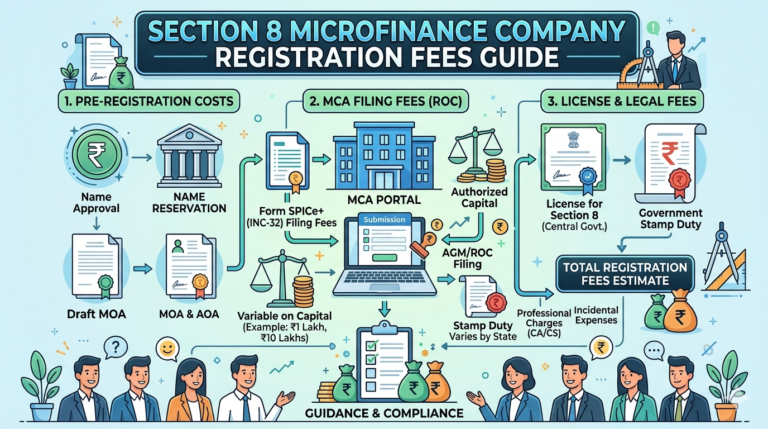
Understanding Section 8 Microfinance Company Registration Fees
The section 8 microfinance company registration fees depend on different factors such as government charges, professional fees, documentation work, and state-level requirements.
There is no fixed fee applicable in every case because costs may vary according to the number of directors, authorized capital, and professional support required during registration.
Main Expenses Involved
Digital Signature Certificate (DSC)
Each proposed director must obtain a Digital Signature Certificate for online filing purposes.
Director Identification Number (DIN)
DIN is required for directors who are part of the company formation process.
Name Approval Fees
The proposed company name is submitted for approval through the Ministry of Corporate Affairs portal.
Government Filing Charges
Registration forms and incorporation documents involve government filing fees.
Professional Consultation Charges
Many organizations take legal or professional assistance for document preparation and filing procedures.
Documents Required for Registration
To complete the registration process, applicants must submit several important documents.
Identity Proof
- PAN card
- Aadhaar card
- Passport (if applicable)
Address Proof
- Electricity bill
- Bank statement
- Telephone bill
Registered Office Proof
- Rent agreement or ownership documents
- No Objection Certificate from property owner
Passport-Size Photographs
Photographs of directors and subscribers are generally required.
NGO Objective Details
Applicants must clearly mention the charitable or social purpose of the organization.
Process to Register NGO as a Section 8 Company
The process to register ngo under the Section 8 structure involves multiple legal steps. Proper documentation helps reduce delays during approval.
Step 1: Obtain DSC and DIN
Directors must first secure Digital Signature Certificates and Director Identification Numbers.
Step 2: Reserve Company Name
The organization submits the proposed name through the official MCA portal.
Step 3: Draft MOA and AOA
The Memorandum of Association and Articles of Association define the objectives and rules of the company.
Step 4: File Incorporation Forms
Required forms and supporting documents are submitted online.
Step 5: Receive Certificate of Incorporation
After verification, the Registrar of Companies issues the incorporation certificate.
Legal Compliance After Registration
Registration is only the first stage. Every Section 8 company must continue following legal requirements after incorporation.
Maintain Proper Accounts
The organization should maintain financial records and transaction details.
Conduct Board Meetings
Regular meetings should be held according to company law requirements.
File Annual Returns
Annual filing with the Registrar of Companies is mandatory.
Follow Income Tax Rules
The organization may also apply for tax-related registrations such as 12AB and 80G certificates.
Difference Between Trust and Section 8 Company
People often compare trust registration with Section 8 registration before selecting a suitable structure.
| Feature | Trust | Section 8 Company |
| Governing Law | Trust Act | Companies Act |
| Management | Trustees | Directors |
| Compliance Level | Moderate | Higher |
| Public Credibility | Good | Strong |
| Operational Structure | Flexible | Formal |
Organizations planning long-term operations with structured management often prefer Section 8 registration.
Common Mistakes During Registration
Many applicants face delays because of incomplete paperwork or incorrect filings.
Incorrect Objective Clause
The company objectives should clearly mention charitable or social activities.
Address Proof Errors
Mismatch in office documents may lead to rejection.
Name Approval Issues
Using restricted or similar company names can delay approval.
Incomplete Documentation
Missing identity proof or unsigned forms may affect the application process.
How Professional Guidance Helps
Legal registration involves documentation, drafting, and compliance procedures. Many NGOs seek professional assistance to avoid technical mistakes and filing errors.
Professional guidance may help with:
- Document preparation
- MOA and AOA drafting
- Government filing procedures
- Compliance support
- Tax registration assistance
Conclusion
Understanding the section 8 microfinance company registration fees is important before starting a non-profit or microfinance organization in India. Along with registration costs, applicants should also consider legal documentation, annual compliance requirements, and operational planning.
The process to register ngo under the Section 8 structure requires careful preparation and proper filing of documents. For organizations looking for a formal structure with legal recognition, section 8 ngo registration can be a suitable option.
For legal guidance related to NGO registration, Section 8 company incorporation, and compliance support, Ngoexperts Official Website provides assistance for charitable organizations and social enterprises across India.