
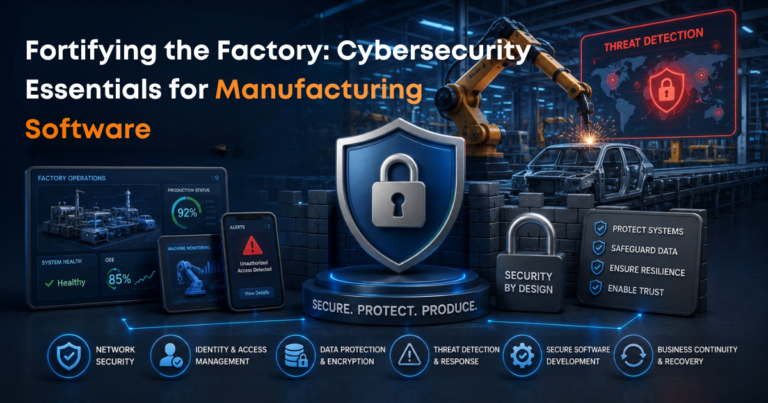
The manufacturing sector is no longer just about heavy machinery and assembly lines. Today, code runs the floor. As physical hardware merges with digital intelligence, the attack surface for cybercriminals expands. Manufacturing remains a primary target for ransomware and industrial espionage. Protecting these assets requires a deep understanding of both Information Technology (IT) and Operational Technology (OT).
When a Manufacturing Software Development Company builds a tool, security cannot be an afterthought. It must be the foundation. This explores the technical essentials of securing modern industrial software.
The Rising Stakes of Industrial Cyber Attacks
Digital transformation brings efficiency but also introduces risk. Legacy systems often lack modern security protocols. Hackers now target the intersection of software and hardware. A single breach can stop production for weeks.
- Financial Impact: The average cost of a data breach in manufacturing reached $4.73 million in 2023.
- Target Frequency: Manufacturing was the most attacked industry for three consecutive years.
- Ransomware Trends: Over 70% of successful ransomware attacks now involve data exfiltration.
These statistics highlight a grim reality. Security is not just a feature. It is a requirement for business continuity.
Understanding the IT and OT Convergence
In the past, factory machines lived on isolated networks. This “air-gapping” provided a natural shield. Modern Manufacturing Software Development removes these gaps to enable real-time data sharing. This convergence creates a bridge that hackers can cross.
IT focuses on data privacy and integrity. OT focuses on safety and availability. If a website goes down, a company loses sales. If a furnace control system fails, a factory might explode. The stakes in manufacturing software involve physical safety.
Secure Coding Practices in Manufacturing
Developers must follow strict protocols during the build phase. Vulnerabilities often stem from poor coding habits.
1. Input Validation and Sanitization
Software must verify every piece of data it receives. This prevents injection attacks. Sensors and HMI (Human Machine Interface) inputs are common entry points for malicious code.
2. Least Privilege Architecture
Every software component should only have the permissions it needs. A data logging tool does not need administrative access to the motor controls. Restricted access limits the “blast radius” of a breach.
3. Secure API Integration
Modern factories use many different apps. These apps talk through APIs. Developers must encrypt these connections. Using OAuth 2.0 or similar frameworks ensures only authorized systems communicate.
The Role of Industrial IoT (IIoT) Security
IIoT devices collect massive amounts of data. These devices are often small and have low processing power. This makes them hard to secure. A specialized Manufacturing Software Development Company focuses on several IIoT security layers:
- Hardware Root of Trust: This ensures the device runs authentic software.
- Firmware Updates: Software must allow for secure, remote updates. Unpatched firmware is a “golden ticket” for hackers.
- Data Encryption: Data must be encrypted both at rest and in transit. Use protocols like AES-256 for maximum protection.
Zero Trust in the Production Environment
The “trust but verify” model is dead. The “never trust, always verify” model replaced it. Zero Trust assumes the network is already compromised.
1. Identity and Access Management (IAM)
Each worker and machine needs a unique digital identity. Multi-factor authentication (MFA) is mandatory. Physical tokens or biometric scans work well in loud, dusty factory environments.
2. Micro-segmentation
Divide the factory network into small zones. If a hacker enters the HVAC control system, they cannot reach the production robots. Segmenting the network traps threats in one area.
Monitoring and Threat Detection
You cannot fix what you cannot see. Continuous monitoring is vital.
1. Anomaly Detection
AI-driven software learns the “normal” behavior of a factory. It flags a motor that starts spinning at 2:00 AM without a scheduled shift. These alerts allow for rapid response.
2. Log Management
Software must record every action. Logs help investigators find the root cause of an attack. These logs must reside in a secure, tamper-proof location.
3. Security Orchestration
Automated tools can shut down compromised segments instantly. This reduces the need for human intervention during a midnight attack.
Protecting the Software Supply Chain
Modern software uses many open-source libraries. If a library has a bug, your software has a bug.
- Software Bill of Materials (SBOM): This is a list of every component in your software. It helps track vulnerabilities in third-party code.
- Vulnerability Scanning: Run automated tests during the development cycle. This catches flaws before the software reaches the client.
- Vendor Audits: Ensure your partners follow the same high standards. A weak link in the supply chain breaks the whole chain.
Disaster Recovery and Incident Response
No system is 100% secure. You must plan for failure.
- Immutable Backups: Keep copies of your data that hackers cannot change or delete.
- Regular Drills: Treat a cyber attack like a fire drill. Everyone must know their role.
- Fast Restoration: Your software should allow for quick re-imaging of machines. Every hour of downtime costs thousands of dollars.
Regulatory Compliance and Standards
Governments are tightening rules on industrial security.
- IEC 62443: This is the international standard for industrial automation security. It provides a framework for both developers and operators.
- NIST Framework: Many companies use the NIST Cybersecurity Framework to manage risk.
- GDPR and Data Privacy: Even factory data can contain personal information about workers. Compliance is mandatory to avoid massive fines.
Case Study: The Cost of Neglect
In 2021, a major colonial pipeline faced a ransomware attack. A single compromised password led to a total shutdown. This affected fuel supplies for millions of people. It proved that software security impacts the physical world.
In another example, the “Stuxnet” worm targeted specific industrial controllers. It changed the speed of centrifuges to cause physical damage. This showed that malicious code can destroy hardware.
Building a Culture of Security
Technology alone cannot solve the problem. People are often the weakest link.
- Training: Teach workers to spot phishing emails.
- Physical Security: Lock server rooms. Disable unused USB ports on the floor.
- Clear Policies: Have strict rules for using personal devices on the factory network.
The Future of Manufacturing Security
We are moving toward autonomous factories. Software will make more decisions without human help. This makes the code even more critical.
- Blockchain for Integrity: Some companies use blockchain to verify parts in the supply chain.
- Quantum-Resistant Encryption: As computers get faster, we need stronger math to protect data.
- Self-Healing Software: Future apps might fix their own vulnerabilities in real-time.
Summary of Key Cybersecurity Steps
| Priority Area | Action Step | Goal |
| Network | Implement Micro-segmentation | Contain breaches to one zone |
| Identity | Require Multi-factor Auth | Prevent unauthorized access |
| Code | Maintain an SBOM | Track third-party risks |
| Data | Use End-to-End Encryption | Protect sensitive information |
| Recovery | Test Immutable Backups | Ensure fast production restart |
Conclusion
Cybersecurity in manufacturing is a continuous process. It is not a one-time setup. As your tools evolve, your defenses must grow too.
Focus on the fundamentals. Use secure coding. Segment your networks. Train your staff. When you invest in Manufacturing Software Development, put security at the top of the list. A secure factory is a productive factory. A compromised one is a liability.
Protect your data, protect your machines, and protect your people. The future of your business depends on the strength of your code.