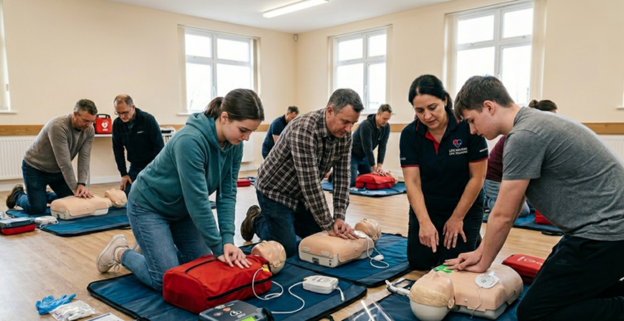
If you’re considering CPR AED training in Minneapolis, it helps to know what you’re actually walking into. It’s not just a box to check or a video to sit through. A well-run class is practical, a bit repetitive by design, and focused on getting you comfortable enough to act without hesitation. You won’t leave as an expert, but you should leave knowing exactly where your hands go and what to do first.
CPR Partner, LLC provides structured, AHA-compliant training designed to support both community responders and healthcare professionals.
Core Skills You’ll Walk Away With
- Recognizing an Emergency
You’ll learn how to quickly assess responsiveness, breathing, and when to step in instead of waiting. - High-Quality CPR Technique
Proper hand placement, compression depth, rhythm, it’s drilled until it feels automatic, not guessed. - Using an AED Correctly
How to power it on, place pads, follow prompts, and avoid common mistakes people make under stress. - Coordinating with Others
In group scenarios, you’ll practice switching roles, calling for help, and keeping things organized. - Handling Choking Situations
Both adult and child choking response techniques are covered, with hands-on practice. - Basic First Aid Awareness
You’ll touch on bleeding control and immediate care steps before professional help arrives. - Staying Calm Under Pressure
This isn’t a formal lesson, but it happens. Repetition builds a kind of muscle memory that steadies you. - Following a Clear Response Sequence
From scene check to action, you’ll learn a structured approach, so you’re not improvising in the moment.
Courses Offered
1. BLS / CPR Classroom
Course Overview: This is the traditional, in-the-room training. You’reworking through compressions, AED use, and team response in real time, with an instructor who can stop you mid-cycle and fix what’s off. That immediate correction makes a difference.
Ideal For: Healthcare professionals, clinical staff, and students who need solid, hands-on repetition
Course Format: Instructor-led classroom session
Certification: American Heart Association BLS Provider eCard (valid for 2 years)
2. BLS / CPR Blended Learning
Course Overview: You handle the theory online at your own pace, then come in for the part that actually counts, the skills check. It’s efficient, especially if you already know the basics.
Ideal For: Healthcare providers trying to fit certification around unpredictable schedules
Course Format:
Part 1: Online learning
Part 2: In-person skills validation
Certification: AHA BLS Provider eCard (valid for 2 years)
3. Heartsaver First Aid, CPR, AED (Total) – Classroom
Course Overview: Broader in scope. You’re not just learning CPR, but how to respond to everyday emergencies, burns, bleeding, choking, the kind of situations that don’t wait for professionals to arrive.
Ideal For: Workplace teams, educators, and anyone responsible for others in a non-clinical setting
Course Format: Classroom-based training
Certification: AHA Heartsaver First Aid CPR AED eCard (valid for 2 years)
4. Heartsaver First Aid, CPR, AED (Total) – Blended Learning
Course Overview: Same material, just split between screen time and in-person assessment. Works well if you’d rather not sit through a full-day class.
Ideal For: People who need flexibility but still want proper certification
Course Format: Online instruction + in-person evaluation
Certification: AHA Heartsaver First Aid CPR AED eCard (valid for 2 years)
5. Pediatric First Aid, CPR, AED – Classroom
Course Overview: Focused, and for good reason. Infant and child emergencies don’t play out the same way as adult cases. This course leans into those differences: airway management, compression depth, and response timing.
Ideal For: Childcare providers, school staff, caregivers
Course Format: Instructor-led classroom training
Certification: AHA Pediatric First Aid CPR AED eCard (valid for 2 years)
6. Pediatric First Aid, CPR, AED – Blended Learning
Course Overview: Covers the same pediatric scenarios, just with the theory handled online first. The in-person session is where you prove you can actually perform the skills.
Ideal For: Those needing pediatric certification without blocking out an entire day
Course Format: Blended learning (online + in-person)
Certification: AHA Pediatric First Aid CPR AED eCard (valid for 2 years)
7. BLS / CPR SKILLS Session
Course Overview: This is strictly the hands-on portion. You’ve already done the online coursework; now it’s about demonstrating that you can perform under observation. No shortcuts here.
Ideal For: Participants who’ve completed the online BLS component
Course Format: In-person skills evaluation
Certification: AHA BLS Provider eCard issued after successful completion
8. Heartsaver First Aid, CPR, AED SKILLS Only
Course Overview: Similar idea, but for the Heartsaver track. You’re coming in to show competency, not to relearn the material.
Ideal For: Those who’ve finished the blended Heartsaver program
Course Format: In-person evaluation session
Certification: AHA Heartsaver First Aid CPR AED eCard
9. Heartsaver Pediatric First Aid, CPR, AED SKILLS Only
Course Overview: Focused evaluation on pediatric scenarios. Instructors pay close attention here, because technique matters more when you’re dealing with infants.
Ideal For: Participants completing pediatric blended learning
Course Format: In-person skills validation
Certification: AHA Pediatric First Aid CPR AED eCard
10. BLS / CPR Renewal
Course Overview: Not just a formality. Guidelines shift, techniques get refined, and this course brings you back up to standard. It’s usually quicker, but it shouldn’t feel rushed.
Ideal For: Previously certified healthcare providers who need to stay current
Course Format: Classroom or blended learning options
Certification: AHA BLS Provider Renewal eCard (valid for 2 years)
Conclusion What tends to stick after a good session isn’t just the steps, it’s the shift in how you respond when something feels off. You notice things faster. You don’t freeze as easily. There’s a kind of quiet confidence that comes from having run through it enough times, even if it was just on a training manikin in a classroom. That’s the real value here. So if you’re looking into First aid training in Minneapolis, don’t settle for something that just gets you certified. Find a course that makes you a little more decisive when it actually counts.