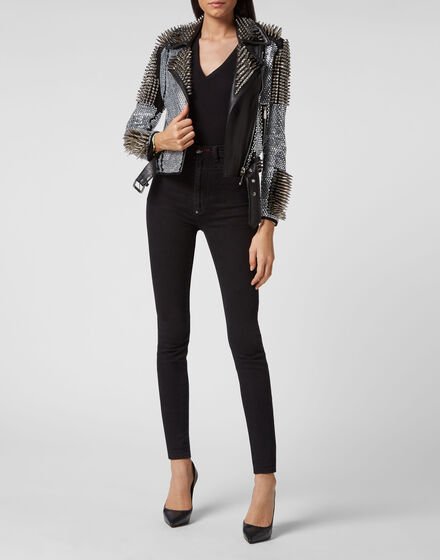
A Garment That Started With Risk, Not Style
The Leather Biker Jacket didn’t begin in fashion studios or runway collections. It originated from a need for protection in a high-risk environment—riding motorcycles at speed, exposed to wind, friction, and impact.
That origin matters because it defines everything about its structure. The jacket was not designed to “look cool” first. It was designed to reduce harm, resist abrasion, and provide a controlled layer between the body and unpredictable road conditions.
Over time, what began as protective equipment slowly moved into everyday clothing. But the foundation never changed—it still carries the logic of protection built into its seams.
Why Leather Was Never Just a Style Choice
The material itself is not decorative. In a Leather Biker Jacket, leather acts as a functional barrier. It resists tearing, handles friction, and adapts over time rather than breaking down immediately.
Unlike synthetic fabrics that prioritize lightness, leather prioritizes endurance. It reacts to use rather than resisting it. This is why older jackets often look better with age instead of worse—they evolve through wear instead of degrading.
This transformation is not accidental. It is part of how the material behaves under real-world conditions.
Structure Built Around Movement
One of the most overlooked aspects of a Leather Biker Jacket is how carefully it is shaped for motion. Every element serves a purpose:
- Sleeves are shaped for forward arm positioning
- Zippers are placed to reduce wind exposure
- Shoulder structure supports riding posture
- Fit is adjusted to reduce flapping at speed
Nothing is random. Even the asymmetrical front zipper—often seen as a style choice—originated as a practical solution to reduce wind intrusion while riding.
This is why the jacket still feels “engineered” compared to most outerwear.
The Shift From Function to Identity
At some point, the Leather Biker Jacket stopped being just riding gear and became a visual symbol. That shift did not happen through redesign—it happened through context change.
Motorcyclists, musicians, actors, and everyday wearers adopted it not because it changed, but because society’s perception of it did.
It began to represent independence, rebellion, and self-direction. These meanings were not built into the material—they were layered onto it over time through cultural association.
This is why the same jacket can feel different depending on who is wearing it.
Why It Still Feels Relevant in Modern Fashion
Unlike many trend-driven garments, the Leather Biker Jacket has not needed reinvention to stay relevant. Its core design has remained stable for decades.
What changes is how it is styled, not how it is built. It can be paired with denim, minimal outfits, formal contrasts, or layered streetwear, but the jacket itself remains unchanged.
This stability is rare in fashion, where most items evolve quickly or disappear entirely after short trend cycles.
The biker jacket persists because it was never dependent on trends to begin with.
The Psychology of Wearing It
Clothing affects behavior more than people often realize. A Leather Biker Jacket carries a certain visual weight. It creates presence.
Wearing it often changes posture, movement, and even perception of confidence. This is not because the jacket has symbolic power on its own, but because it has been culturally associated with strong visual identities for decades.
In that sense, it functions as a kind of social shorthand. People interpret it quickly, even without consciously thinking about it.
Aging as Part of the Design System
One of the most defining features of a Leather Biker Jacket is how it ages. Unlike garments that are expected to remain visually identical over time, leather is meant to change.
Scratches, creases, and softened areas are not defects—they are records of use. The jacket becomes more individual the longer it is worn.
This is why no two older biker jackets look the same. Each one develops its own pattern based on movement, environment, and frequency of use.
Why It Doesn’t Fit Into a Single Category
Trying to label a Leather Biker Jacket purely as fashion or purely as utility misses its actual identity. It exists in both spaces at once.
It is protective gear that became cultural clothing. It is functional design that became symbolic. It is structured engineering that became aesthetic identity.
That overlap is what makes it difficult to replace or replicate meaningfully.
Conclusion: A Design That Outlives Its Original Purpose
The Leather Biker Jacket remains relevant not because it changes with fashion, but because it was built on principles that don’t expire—protection, structure, and durability.
Its evolution from riding gear to cultural icon did not require redesign. It required reinterpretation.
And even today, it continues to sit in that unusual space where function and identity meet, unchanged in structure but constantly redefined by the people who wear it.