India’s alcoholic beverage market is projected to reach USD 64.7 billion by 2030, growing at a CAGR of 7.8%. For most alcohol brands, building and running a captive distillery is neither fast nor financially sensible. Contract manufacturing alcohol India where a brand owner partners with a licensed distillery for production is how many global and domestic brands get to market quickly without owning a plant. In this post, you will learn what contract manufacturing in spirits actually involves, why India is a preferred destination, how quality gets maintained, and what the real cost advantages look like.
What Is Contract Manufacturing in the Alcohol Industry?
Contract manufacturing in the alcohol industry means a brand owner commissions a licensed, third-party distillery to produce, blend, and bottle spirits under the brand owner’s specifications and label. The brand retains ownership of the formulation, recipe, and trademark. The manufacturer provides the facility, equipment, raw materials, and regulatory compliance infrastructure.
This model is common across IMFL (Indian Made Foreign Liquor) segments whisky, rum, vodka, and gin where production capacity, raw material sourcing, and excise compliance are all managed by the contract distillery.
How a Contract Manufacturing Agreement Works
A typical agreement covers production volumes, quality specifications, raw material standards, packaging requirements, and excise documentation responsibilities. The brand owner supplies the recipe or blend specifications. The manufacturer handles day-to-day production and statutory filings with state excise authorities.
What Types of Alcohol Are Produced Under Contract?
Whisky (ENA-based and malt), rum, brandy, vodka, and gin are the most common. Some manufacturers also produce bulk ENA (Extra Neutral Alcohol) for supply to other producers. White label production where a single facility produces multiple brand variants simultaneously is increasingly common among mid-size brands entering new state markets.
Why Do Alcohol Brands Outsource Production in India?
Alcohol brands outsource production in India primarily because building a greenfield distillery requires significant capital investment, multi-year timelines, and state-specific licensing that varies across 28 states. Outsourcing removes that barrier entirely and lets brands focus on marketing, distribution, and brand-building.
India’s alcohol production ecosystem is well-established, with surplus distillery capacity across Madhya Pradesh, Maharashtra, Uttar Pradesh, and Telangana. This creates a buyer’s market for contract manufacturing agreements.
Access to Established Distillery Infrastructure
Indian contract distilleries often hold existing FSSAI registrations, state excise licences, and GMP certifications. A brand entering through contract manufacturing inherits this compliance infrastructure rather than building it from scratch. This typically reduces time-to-market from 3–5 years (greenfield) to 6–18 months.
Geographic Reach Through Multi-State Production
Alcohol in India faces inter-state movement restrictions. A brand that manufactures in one state cannot always sell in another without local production or bonded warehouse arrangements. Contract manufacturing facilities in multiple states solve this. A brand can tie up with regional manufacturers to serve each state market without a physical presence everywhere.
Flexible Production Volumes
Contract manufacturing lets brands produce in smaller initial batches, test market response, and scale production without idle capacity costs. This is especially relevant for new product launches or limited editions where demand is uncertain.
What Are the Cost Benefits of Alcohol Contract Manufacturing?
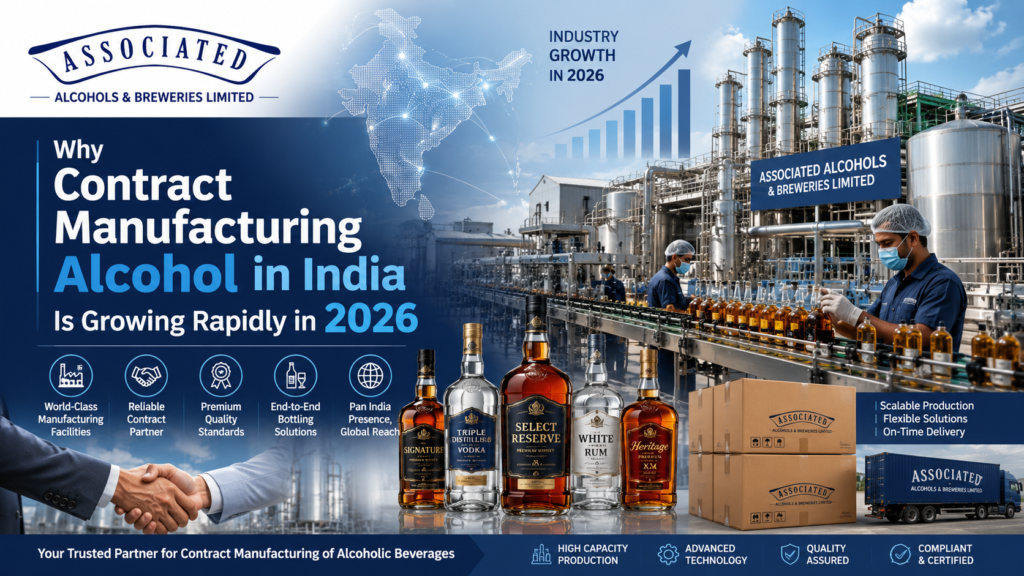
The primary cost advantage is the elimination of fixed capital expenditure on plant, equipment, and land. Contract manufacturing converts capital costs into variable production costs brands pay per case produced, not for underutilised plant capacity.
Beyond capital savings, contract manufacturers offer economies of scale on raw materials, packaging, and utilities that a small or new brand cannot replicate independently.
- No capex on distillery equipment: Pot stills, continuous column stills, blending tanks, and bottling lines require crores of investment. Contract partners already own this infrastructure.
- Lower working capital requirement: Raw material procurement, ENA inventory, and packaging stock are largely managed by the manufacturer.
- Shared compliance costs: Excise documentation, laboratory testing, and statutory audits are handled centrally by the manufacturer across all clients.
- Faster break-even: Without the depreciation burden of owned plant, brands reach profitability on a lower volume base.
For a detailed example of how established contract production facilities are structured and what they typically offer, this overview of contract manufacturing capabilities in Indian distilleries shows the range of brands and production arrangements that a single facility can support.
How Do Quality Standards Work in Contract Alcohol Production?
Quality in contract alcohol manufacturing is governed through a combination of FSSAI regulations, state excise standards, and contractual quality agreements between the brand and the manufacturer. The brand owner specifies exact sensory and chemical parameters alcohol strength, colour, aroma profile, and filtration standard and the manufacturer is contractually bound to meet them on every batch.
Most large contract facilities run in-house laboratories for routine testing and submit periodic samples to government-approved third-party labs for compliance verification. Batch traceability, raw material sourcing records, and blending logs are maintained for excise audits.
Role of FSSAI and State Excise in Maintaining Standards
FSSAI sets minimum standards for potable alcohol production under the Food Safety and Standards (Alcoholic Beverages) Regulations, 2018. State excise departments conduct periodic inspections and require pre-approval of label designs, blend formulations, and price filings. Contract manufacturers typically manage these submissions on behalf of client brands.
How Brand Owners Protect Formulation Integrity
Brand owners protect their recipes through legally binding non-disclosure clauses in manufacturing agreements. Critical blend ratios or flavouring compounds are often supplied by the brand owner directly to the facility, rather than sourced locally. This ensures the contract manufacturer cannot replicate the product independently.
Is India a Good Location for Outsourcing Alcohol Production?
India is one of the most cost-competitive locations globally for alcohol production, primarily due to low-cost molasses and grain feedstock for ENA, an established bottling industry, and competitive skilled labour rates. India is the world’s largest whisky market by volume, which means contract facilities are already calibrated for high-volume production at competitive cost.
The excise framework, while complex, is well-understood by established manufacturers who have navigated it for decades. For international brands entering India, partnering with a domestic contract manufacturer is often the only practical route given restrictions on imported spirits pricing and labelling.
Conclusion
Contract manufacturing alcohol India gives brands a fast, capital-efficient, and compliance-ready path into one of the world’s largest spirits markets. The model works best when both parties formalise quality expectations in writing, establish clear excise responsibility, and build in production flexibility for demand fluctuations. As India’s middle-class consumer base expands and premium spirits demand grows, more brands domestic and international will turn to contract manufacturing as their default production strategy. The real question is not whether to outsource, but which facilities have the right certifications, capacity, and track record for your specific category.