
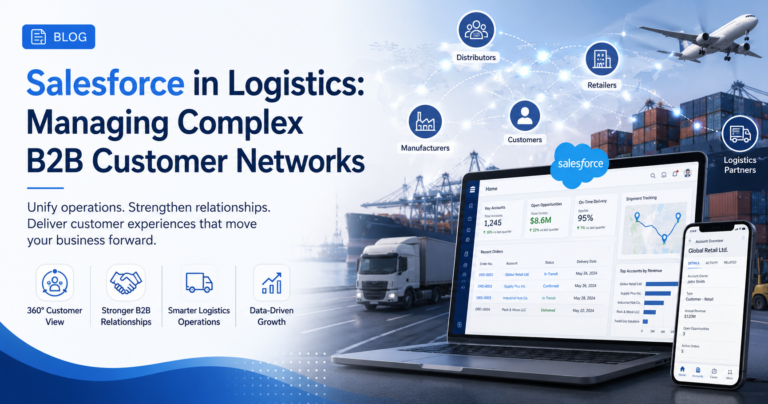
The logistics industry has changed rapidly due to increasing customer expectations, global supply chain complexity, and the growing demand for real-time visibility. Modern logistics providers manage extensive networks that include manufacturers, distributors, retailers, carriers, freight brokers, and other business partners, making customer relationship management more challenging than ever.
Industry data highlights this trend. The World Trade Organization (WTO) reports continued growth in global trade activities, while Gartner research shows that digital transformation remains a key priority for logistics organizations seeking better operational visibility. In addition, Salesforce’s State of the Connected Customer report indicates that B2B buyers increasingly expect personalized communication, transparency, and faster responses from service providers.
As a result, logistics companies must manage not only shipments but also complex customer networks involving multiple stakeholders, contracts, service agreements, and communication channels. Salesforce helps address these challenges by centralizing customer data, sales activities, service interactions, and operational information, giving organizations a unified view of their business relationships and improving coordination across the supply chain.
Why Customer Networks in Logistics Are Different
Many CRM discussions focus on traditional sales environments where businesses engage directly with individual customers. Logistics operates differently.
A single customer account may involve multiple departments, procurement teams, warehouse managers, transportation coordinators, finance stakeholders, and third-party service providers. Each participant influences purchasing decisions, operational execution, and customer satisfaction.
Consider a global manufacturing company that ships products across multiple regions. The logistics provider may interact with:
- Procurement managers negotiating contracts
- Operations teams managing inventory
- Warehouse supervisors coordinating shipments
- Customs brokers handling compliance requirements
- Finance teams managing invoicing
- Regional distribution partners
Each interaction generates valuable information that affects future business decisions.
Without a centralized system, these relationships often become fragmented across spreadsheets, emails, disconnected applications, and departmental databases.
As customer networks expand, maintaining visibility becomes increasingly difficult.
The Cost of Fragmented Customer Information
Many logistics organizations still struggle with disconnected systems.
Sales teams manage opportunities through one platform. Customer service teams use another. Operations teams rely on transportation management systems. Finance departments maintain separate records for contracts and billing.
This fragmentation creates several business risks.
Inconsistent Customer Experiences
Customers expect every department to understand their requirements and service history.
When teams operate from separate data sources, customers often repeat information multiple times. Service requests take longer to resolve, and communication becomes inconsistent.
Reduced Cross-Selling Opportunities
Logistics providers frequently offer multiple services, including transportation, warehousing, fulfillment, customs management, and supply chain consulting.
Without a unified customer view, identifying expansion opportunities becomes significantly more difficult.
Delayed Decision-Making
Managers require accurate information to evaluate account performance, contract renewals, and operational risks.
Fragmented systems slow reporting and reduce confidence in business decisions.
Limited Relationship Visibility
Many logistics contracts involve multiple stakeholders within a customer organization.
Disconnected systems make it difficult to understand relationship structures, key decision-makers, and account influence networks.
Salesforce as a Centralized Relationship Platform
Salesforce addresses these challenges by providing a single environment for managing customer relationships across the entire business lifecycle.
Instead of maintaining customer information across multiple disconnected systems, organizations can create a centralized repository for account data, interactions, contracts, opportunities, service requests, and operational activities.
This centralized approach supports better visibility across customer networks and improves collaboration between departments.
For logistics organizations, the value extends beyond traditional CRM functionality.
Salesforce can become a relationship management platform that connects commercial activities with operational execution.
Mapping Complex B2B Relationships
One of Salesforce’s most valuable capabilities for logistics providers is relationship mapping.
Large B2B accounts often contain complex organizational structures.
A global retailer may operate multiple subsidiaries, distribution centers, regional procurement teams, and logistics coordinators. Each group may influence purchasing decisions in different ways.
Salesforce enables organizations to capture these relationships through account hierarchies and relationship mapping tools.
This visibility helps teams answer critical questions:
- Who are the primary decision-makers?
- Which stakeholders influence contract renewals?
- Which business units generate the highest revenue?
- How are regional operations connected?
- Where do service issues create broader account risks?
Understanding these relationships improves account management and supports long-term customer retention.
Connecting Sales, Service, and Operations
Customer relationships in logistics extend far beyond sales.
A customer may sign a contract with the sales team but interact daily with operations, customer service, billing, and account management personnel.
Salesforce enables organizations to connect these functions through a shared platform.
For example:
When a customer submits a service issue, account managers can immediately view the case history.
When operations encounter shipment disruptions, customer service representatives can access relevant shipment details.
When contract renewal discussions begin, sales teams can review historical service performance and customer interactions.
This level of visibility reduces communication gaps and improves coordination across departments.
Integrating Salesforce with Logistics Systems
Salesforce becomes particularly valuable when integrated with operational platforms.
Most logistics organizations rely on systems such as:
- Transportation Management Systems (TMS)
- Warehouse Management Systems (WMS)
- Enterprise Resource Planning (ERP) platforms
- Fleet management solutions
- Shipment tracking systems
- Billing and financial applications
Integration allows customer-facing teams to access operational information without switching between multiple systems.
For example, account managers can review shipment status, delivery performance, inventory levels, and service metrics directly within Salesforce.
This capability creates a more complete view of customer operations and supports more informed business discussions.
Real-World Example: DHL and Salesforce
A practical example of Salesforce adoption in logistics can be seen in DHL’s customer engagement initiatives.
As one of the world’s largest logistics providers, DHL manages a vast network of customers, partners, and operational stakeholders across multiple regions.
The company has used Salesforce technologies to improve customer engagement, enhance visibility into customer interactions, and support digital transformation initiatives across its operations.
By centralizing customer information and improving coordination between business functions, DHL has been able to create a more connected customer experience while supporting large-scale operational complexity.
The example demonstrates how logistics organizations can use Salesforce not merely as a sales platform but as a broader customer relationship ecosystem.
The Role of Custom Salesforce Development
While standard Salesforce functionality provides significant value, logistics organizations often require customizations to address industry-specific workflows.
Shipment management processes, contract structures, pricing models, compliance requirements, and operational reporting needs vary widely across organizations.
As a result, many companies work with a specialized Salesforce Development Company to tailor the platform to their operational environment.
Custom development may include:
- Logistics-specific workflows
- Customer portals
- Shipment visibility dashboards
- Automated service notifications
- Contract management tools
- Custom reporting and analytics
These enhancements help organizations align Salesforce with their unique business requirements.
Similarly, Salesforce Development Services often focus on integrating Salesforce with existing logistics technologies while improving data consistency and process efficiency.
Measuring Business Impact
Organizations investing in customer relationship visibility typically focus on measurable outcomes.
Several performance indicators often improve after successful Salesforce implementation.
Customer Retention
Improved relationship visibility helps account teams identify risks before they affect contract renewals.
Faster Response Times
Centralized information enables customer service teams to resolve issues more efficiently.
Revenue Growth
Better visibility into customer networks often reveals expansion opportunities across existing accounts.
Operational Coordination
Departments can access shared information, reducing delays caused by disconnected systems.
Forecast Accuracy
Sales teams gain better insight into account activity, pipeline development, and future revenue opportunities.
While results vary by organization, improvements in these areas frequently contribute to stronger customer relationships and more predictable business performance.
Future Trends in Logistics Customer Management
The logistics sector continues to evolve as supply chains become increasingly connected and data-driven.
Future customer relationship strategies will likely rely more heavily on:
- Predictive analytics
- AI-assisted account management
- Real-time shipment intelligence
- Integrated customer portals
- Automated service workflows
- Supply chain visibility platforms
As these capabilities expand, centralized customer relationship management will become even more important.
Organizations that maintain fragmented customer information may struggle to keep pace with growing expectations for transparency and responsiveness.
Final Thoughts
Managing customer relationships in logistics involves far more than tracking sales opportunities. Modern logistics providers operate within complex networks that include customers, suppliers, carriers, distributors, and internal stakeholders spread across multiple locations and business functions.
Without centralized visibility, these relationships become difficult to manage effectively. Information silos, communication gaps, and disconnected systems can negatively affect customer satisfaction, operational performance, and revenue growth.
Salesforce provides a practical solution by creating a unified platform for managing customer interactions, account structures, operational activities, and business opportunities. Through integration, relationship mapping, and customized workflows, logistics organizations can gain greater visibility into their customer ecosystems and improve coordination across departments.
For businesses managing complex B2B networks, partnering with an experienced Salesforce Development Company and leveraging specialized Salesforce Development Services can help align Salesforce capabilities with operational requirements while supporting long-term scalability and customer success.