Your baby is fed, changed, and held — but still inconsolably fussy. Your nipples are cracked and sore. Your little one takes forever at the breast but never seems satisfied. If this sounds familiar, you’re not imagining things. These are some of the most commonly overlooked signs of feeding dysfunction in babies — and in many cases, an undiagnosed tongue-tie or lip-tie is the silent culprit. And if your child is past the infant stage? These restrictions don’t simply disappear. Untreated tongue-tie and lip-tie in older children can affect speech, sleep, eating, and dental health in ways many families never connect back to the original source.
At the Alabama Tongue-Tie Center, we see families every week who spent months — sometimes years — struggling before anyone identified the real root cause. This guide will help you spot the signs early, understand lip tie baby symptoms, and know when it’s time to explore tongue tie treatment for older children or lip tie surgery.
What is feeding dysfunction in babies?
Feeding dysfunction refers to any difficulty a baby has with the process of eating — whether breastfeeding or bottle-feeding — that interferes with proper nutrition, weight gain, or comfort. It’s not just about a “fussy” baby. Feeding dysfunction can affect a child’s growth, sleep, speech development, and even their long-term dental health.
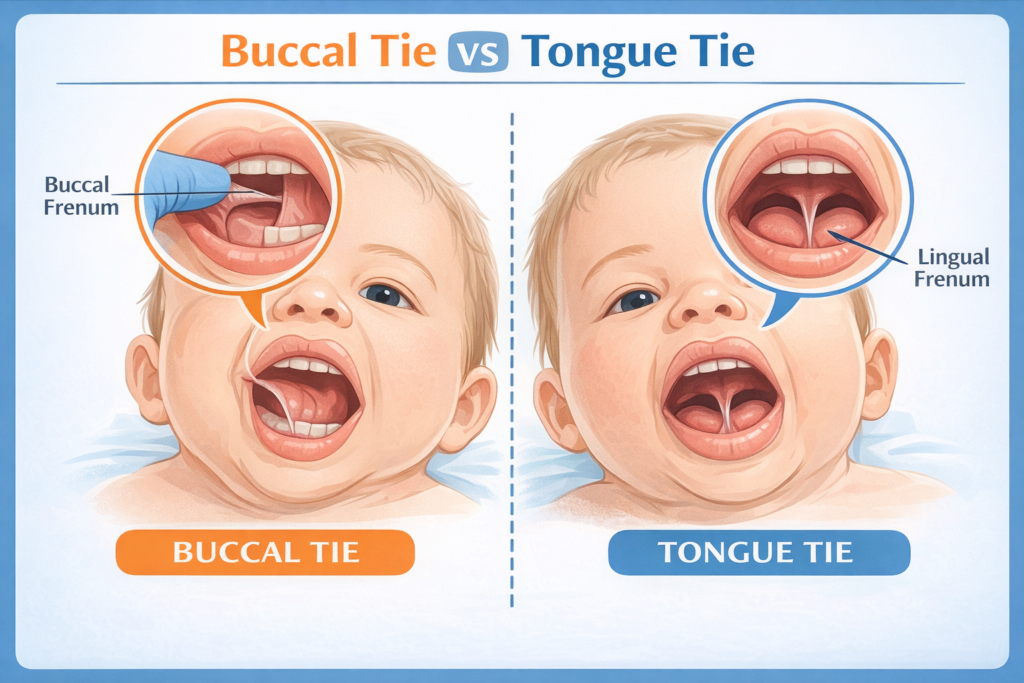
One of the most underdiagnosed causes of infant feeding dysfunction is ankyloglossia — commonly known as tongue-tie — where a short or tight band of tissue under the tongue restricts normal tongue movement. Lip-ties, which involve similar tissue connecting the upper lip to the gum, often accompany tongue-ties and significantly compound feeding difficulties.
10 hidden signs of feeding dysfunction in babies
Sign 01
Clicking or smacking sounds while feeding
If you hear a clicking, popping, or smacking sound when your baby nurses or bottle-feeds, this is a red flag. It means your baby is repeatedly breaking suction — often because a restricted tongue cannot maintain a proper seal on the breast or nipple. This is one of the earliest and most telling signs that something is off with your baby’s oral function.
Sign 02
Excessive gas, bloating, and reflux
When a baby can’t latch properly, they swallow large amounts of air with every feed. This trapped air leads to gas, bloating, frequent spitting up, and what looks like reflux. Many parents and even pediatricians treat these symptoms with reflux medication — when the actual fix is addressing the underlying oral restriction causing inefficient swallowing.
Sign 03
Exhaustion or falling asleep mid-feed
Feeding should not be this hard. A tongue-tied baby has to work two to three times as hard as other babies just to transfer milk. The extra effort is exhausting — so they fall asleep at the breast or bottle long before they’ve taken in enough food, then wake up hungry again within an hour, creating a cycle of frequent, short, unsatisfying feeds.
Sign 04
Slow or poor weight gain
This is one of the most serious consequences of feeding dysfunction. When a baby can’t transfer milk efficiently, they simply don’t get enough calories to grow. If your baby is consistently falling behind on the weight chart despite frequent feedings, a restricted tongue or lip should be among the first things evaluated — not the last.
Sign 05
Lipstick-shaped or creased nipples after feeding
This one is a sign you see on mom, not baby. When your nipple looks flattened, creased, or shaped like a tube of lipstick after a feed, your baby is not using their tongue correctly. Instead of cupping and compressing the breast with full, rhythmic tongue movement, they’re compensating with jaw pressure — a direct result of a tongue that can’t move freely.
Sign 06
Constant nursing without feeling satisfied
Nursing for 45 minutes and still seeming hungry? Tongue-tied babies often can’t drain the breast efficiently, getting only the foremilk and missing the fat-rich hindmilk. This leaves them unsatisfied and can trigger oversupply, engorgement, and mastitis in breastfeeding mothers.
Sign 07
Mouth breathing and restless sleep
A tongue-tied baby often can’t rest their tongue against the roof of the mouth, which means they default to mouth breathing — especially during sleep. This leads to poor-quality, restless nights for the whole family, and over time can contribute to a narrow, high-arched palate that affects dental development into childhood.
Sign 08
Lip blisters — a classic lip tie baby symptom lip tie
Small blisters or calluses on your baby’s upper lip — often called sucking blisters or cobblestone blisters — are among the most recognizable lip tie baby symptoms. When the upper lip is tethered too tightly by an abnormal frenulum (a lip-tie), the baby overuses their lips to create suction. This friction causes the blisters. If you notice these paired with difficulty latching, flared upper lip during nursing, or gaps between the upper lip and breast, a lip-tie evaluation is strongly recommended.
Sign 09
Difficulty transitioning to solid foods
A tongue-tie that seemed manageable in infancy often becomes more apparent when solid foods are introduced. Parents notice gagging on age-appropriate textures, difficulty moving food around the mouth, pocketing food in cheeks, or outright refusal of anything beyond purees. These are signs of oral motor dysfunction that frequently trace back to a restriction that was never addressed.
Sign 10
Recurring ear infections
A restricted tongue can affect how the muscles around the Eustachian tubes function, making it harder for the middle ear to drain properly. This creates the perfect environment for recurring ear infections. If your child has had three or more ear infections in a short period, evaluating tongue function — not just the ears themselves — may reveal the underlying cause.
Important note: Your baby doesn’t have to show all of these signs to have a tongue-tie or lip-tie. Some babies show only one or two — and even a single persistent sign warrants a professional functional evaluation.
Lip tie baby symptoms: what to look for specifically new section
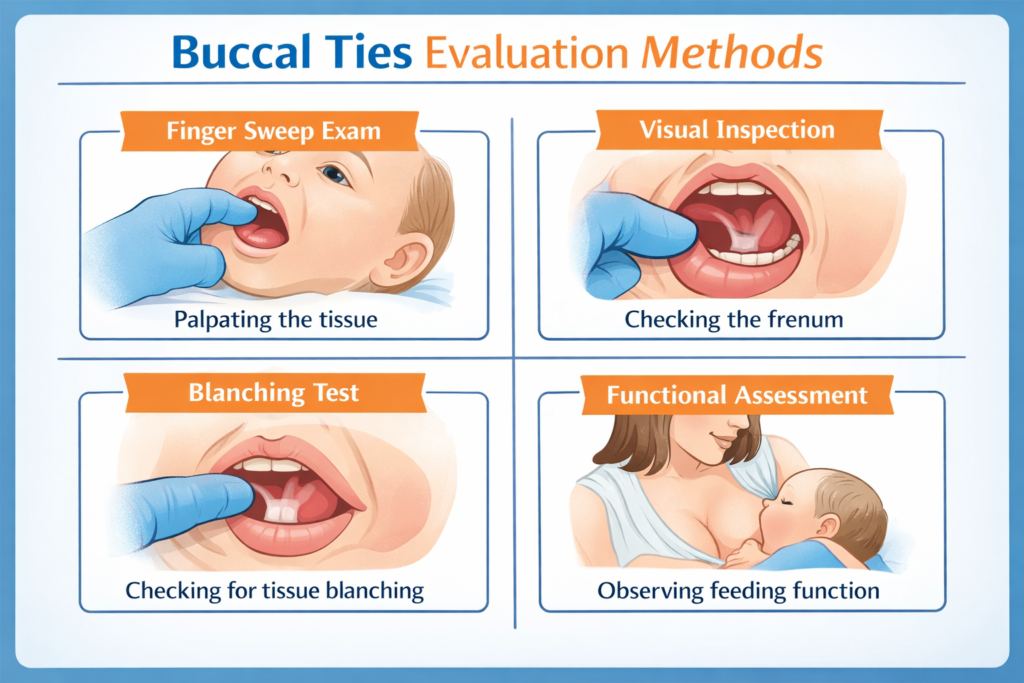
Lip-ties are frequently overlooked because parents — and even many healthcare providers — focus primarily on the tongue. But lip tie baby symptoms are distinct and worth knowing. The upper lip frenulum connects the inside of the upper lip to the gum tissue above the front teeth. When this tissue is unusually short or thick, it restricts how far the upper lip can flare outward during feeding.
Infant lip tie signs
- Upper lip curls inward during nursing
- Visible gap between lip and breast/bottle
- Sucking blisters on the upper lip
- Milk leaking from corners of mouth
- Fatigue during feeding
- Poor latch that doesn’t improve with positioning
Signs in toddlers & beyond
- Gap between upper front teeth (diastema)
- Difficulty brushing upper gum line
- Dental decay near the gum line
- Restricted lip movement during speech
- Upper lip appears “tied” when smiling
- Difficulty with certain foods or utensils
It’s important to note that a lip-tie alone doesn’t always cause problems – but when combined with a tongue-tie, the combined effect on feeding and oral development can be significant. A thorough functional assessment evaluates both together.
Tongue tie treatment for older children: it’s never too late new section
One of the most common questions we hear is: “My child is 6 (or 8, or 12) – is it too late to do anything?” The answer is no. Tongue tie treatment for older children is not only possible – in many cases, it’s life-changing.
When a tongue-tie goes undetected in infancy, children often develop compensation patterns: they learn to speak, eat, and swallow in ways that work around the restriction. But these patterns can have real consequences that build over time..
How tongue-tie affects older children
In school-age children and teenagers, an untreated tongue-tie or lip-tie can present as speech difficulties — particularly with sounds that require the tongue tip to reach the roof of the mouth, like “l,” “r,” “t,” “d,” “n,” and “th.” Children may have already spent years in speech therapy with limited progress, not realizing that a structural restriction is working against them.
Sleep is another major concern. Children with tongue-ties are at higher risk for sleep-disordered breathing, mouth breathing at night, and symptoms that can mimic ADHD – including hyperactivity, impulsivity, difficulty focusing, and mood dysregulation. If your older child snores, tosses and turns, or wakes up exhausted despite a full night’s sleep, tongue function is worth evaluating.
Dental consequences are also common. When the tongue can’t rest in proper position against the palate, it fails to provide the gentle constant pressure that shapes the dental arch. This can result in a narrow palate, crowded teeth, overbite, and the need for more extensive orthodontic treatment down the line.
Lip tie surgery: what parents need to know new section
If your baby or child has been assessed and a lip-tie is determined to be causing functional problems, lip tie surgery — more accurately called a labial frenectomy or frenuloplasty — is a simple, fast, and highly effective procedure.
At the Alabama Tongue-Tie Center, we use a precise CO₂ laser to release the lip frenulum. The laser technique offers several advantages over traditional scissors or scalpel methods: minimal bleeding, reduced risk of infection, greater precision, and faster healing. For infants, the procedure takes only a few minutes and most babies feed better within the same day. For older children, recovery is similarly quick – most return to normal activities the very next day.
Lip tie surgery is not cosmetic and is not taken lightly. Our team performs a thorough functional assessment before recommending any procedure. Not all lip-ties require surgery – the decision is always based on whether the restriction is causing measurable functional problems for your child. When it is, treatment can open the door to improved feeding, better dental health, and a more comfortable childhood.
Why are these signs so often missed?
Many of these signs are dismissed as “normal newborn behavior” – because in isolation, any one of them might be. Healthcare providers who aren’t specifically trained in infant oral function may not connect the dots. Posterior tongue-ties are especially likely to be missed because they aren’t visually obvious during a quick oral exam. This is why a functional assessment – not just a visual check – is essential.
Frequently asked questions
Can a tongue-tie or lip-tie go undetected by my pediatrician?
Yes — particularly posterior tongue-ties and lip-ties, which are harder to spot during a routine checkup. A functional assessment by a trained specialist is the most reliable way to identify a restriction and understand how it’s affecting your child’s health.
What are the most common lip tie baby symptoms to watch for?
The most common lip tie baby symptoms include the upper lip curling inward during nursing, milk leaking from the corners of the mouth, sucking blisters on the upper lip, and a poor latch that doesn’t improve with positioning changes. In older children, a gap between the upper front teeth and restricted lip movement are also common signs.
Is tongue tie treatment for older children different from infant treatment?
The release procedure is similar, but older children typically benefit from myofunctional therapy before and after the procedure to retrain the tongue muscles and establish healthy movement patterns. Our team creates age-appropriate treatment plans to ensure the best outcomes for children of all ages.
Is lip tie surgery painful?
With our CO₂ laser technique, lip tie surgery is fast and minimally uncomfortable. Infants may receive a small amount of topical numbing. Older children receive local anesthetic. Most patients experience only mild soreness for a few days, which is well-managed with over-the-counter pain relief.
How do I know if my baby’s feeding issues are caused by a tongue-tie or lip-tie?
The most reliable way is a professional functional assessment. If you’re seeing multiple signs from this list — especially persistent latch problems, poor weight gain, or excessive gas — request an evaluation specifically with a provider trained in infant oral function.