
Author

kriankita2201

Browsing

As a doctor who treats patients with chronic headaches, I hear the same pattern again and again. A patient comes in describing blinding headaches that strike mid‑morning or late afternoon. They have tried every painkiller. They have had scans that show nothing. Then I ask a simple question: “When did you last eat before the headache started?” Often, the answer is a long pause. “I was busy. I skipped breakfast.” Or “I had a late lunch because of meetings.”

Let me be clear. Skipping meals does not cause migraines. But for someone who is already prone to them, missing a meal can be the trigger that turns a quiet day into a lost one. Understanding this connection can give you a powerful, drug‑free tool to reduce your migraine frequency.

Why Your Brain Reacts to an Empty Stomach

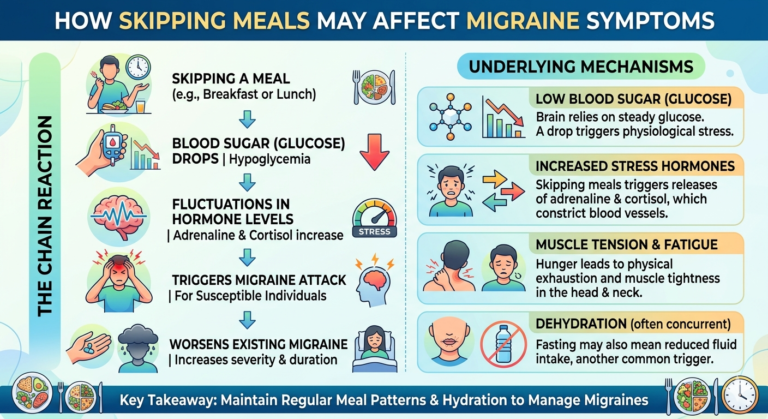
Your brain runs on glucose. Unlike your muscles, which can use fat or protein for energy, your brain is picky. It needs a constant supply of glucose from your bloodstream. When you skip a meal, your blood sugar drops. That is called hypoglycemia.

For most people, mild hypoglycemia causes some shakiness, sweating, and irritability – the classic “hangry” feeling. For someone with a migraine tendency, that same drop in blood sugar sets off a cascade of events. Blood vessels in the brain may dilate. Certain nerves become hyperactive. Inflammation pathways are activated. Within a few hours, a full migraine can develop.

This is not in your head. It is biology.

The Timing Matters More Than You Think

Not all meal skips are equal. The most dangerous time for a migraine patient is mid‑morning, roughly 10 to 11 AM. By then, breakfast has been used up. If you ate nothing or very little in the morning, your blood sugar is at its lowest point of the day. That is why so many patients report migraines that hit late morning.

Late afternoon, around 3 to 4 PM, is the second danger zone. Lunch has worn off, and dinner feels far away. Add the accumulated stress of the workday, and you have a perfect storm for a migraine.

Skipping dinner is less likely to trigger a migraine immediately, but it can lead to low blood sugar overnight, triggering a migraine on waking up the next morning.

Which Meals Matter Most?

Breakfast is the most important meal for migraine prevention. After an overnight fast of eight to ten hours, your brain needs fuel. A person who is not prone to migraines might skip breakfast and feel fine. A migraine patient who skips breakfast is playing with fire. A small, balanced breakfast – not just a cup of coffee – stabilises blood sugar and sets the tone for the day.

Lunch is the second most important. A very light lunch, or a lunch that is mostly refined carbohydrates like white rice or pasta, can cause a rapid rise in blood sugar followed by a sharp crash a few hours later. That crash is exactly what triggers migraines in susceptible people.

What a Migraine‑Friendly Eating Pattern Looks Like

You do not need a complicated diet. You need consistency. Eating every three to four hours keeps blood sugar stable. That means three moderate meals plus one or two small snacks. A handful of nuts in the mid‑morning. A piece of fruit in the afternoon. These small actions can reduce migraine frequency dramatically for some patients.

The snacks do not need to be large. They just need to have some protein, some fat, and some complex carbohydrate. Think apple with peanut butter, yogurt with a few almonds, or a hard‑boiled egg. Avoid sugary snacks. They spike your blood sugar, which then crashes an hour or two later – exactly what you are trying to prevent.

The Role of Dehydration

Here is something many patients miss. When you skip a meal, you often also skip fluids. Dehydration is an even stronger migraine trigger than low blood sugar for many people. If you are rushing through a busy day without stopping to eat, you are probably also not drinking enough water.

The combination of low blood sugar and dehydration is potent. That is why a patient who skips lunch and works through the afternoon with just coffee is almost guaranteed to trigger a migraine by late afternoon. Coffee is a diuretic – it makes you lose water. It is not a substitute for food or water.

When Skipping Meals Is Unavoidable

I understand that life gets in the way. You have back‑to‑back meetings. You are travelling. You are a student with an exam schedule. You cannot always eat on your perfect three‑hour schedule.

When you know you will have to delay a meal, plan ahead. Keep a small emergency snack in your bag or desk drawer. A granola bar, a small pack of nuts, or even a piece of fruit can be enough to keep your blood sugar from crashing. If you absolutely cannot eat, drink a glass of water with a tiny pinch of salt. It is not a substitute for food, but it can help stabilise your system temporarily.

What If You Already Have a Migraine?

If you feel a migraine coming on and you realise you have not eaten for hours, do not stuff yourself. That can worsen nausea and vomiting. Instead, eat a small, easily digestible snack.A few crackers, a banana, or a small glass of milk. The goal is to raise your blood sugar gradually, not to flood your stomach.

Then take your usual rescue medication. The combination of medication and stabilising your blood sugar is more effective than either alone.

When to See a Neuro Expert

If you have made consistent changes to your eating pattern – regular meals, balanced snacks, good hydration – and your migraines are still frequent and disabling, you need a specialist. Do not blame yourself. Meal skipping is only one trigger among many. Hormones, sleep, stress, weather, and genetics all play roles.

If you live in or around Ranchi, you should consult with a Neuro Expert doctor in Ranchi for a full evaluation. They can check for other triggers, review your medication regimen, and help you build a comprehensive prevention plan. For ongoing management of chronic migraine, a Neuro Doctor in Ranchi can guide you through everything from lifestyle adjustments to preventive medications to newer treatments like CGRP blockers.

Final Thoughts from My Desk

Skipping a meal will not cause a migraine in a person who is not already prone to them. But for someone with a migraine tendency, it is one of the most reliable triggers. The good news is that it is also one of the easiest to control. You do not need expensive tests or complicated treatments. You just need to eat.

Set reminders on your phone if you have to. Keep snacks in your bag. Do not let “being busy” be the reason you lose a day to a migraine. Your brain is not being dramatic. It is asking for fuel. Feed it.
Let me start with something I hear from women of all ages. “My periods are painful, but I think it’s normal. Everyone says periods hurt.” And that is the problem. So many women have been told, for years, that severe pain is just part of being female. They learn to grit their teeth, pop a painkiller, and carry on. But here is the truth that no one tells you. Mild to moderate discomfort is normal. Pain that stops you from living your life is not. And confusing the two can mean suffering for years with a treatable condition for no good reason.

Let me walk you through exactly how to tell the difference, when to stop toughing it out, and when to see a doctor.

What Happens Inside Your Body During Your Period

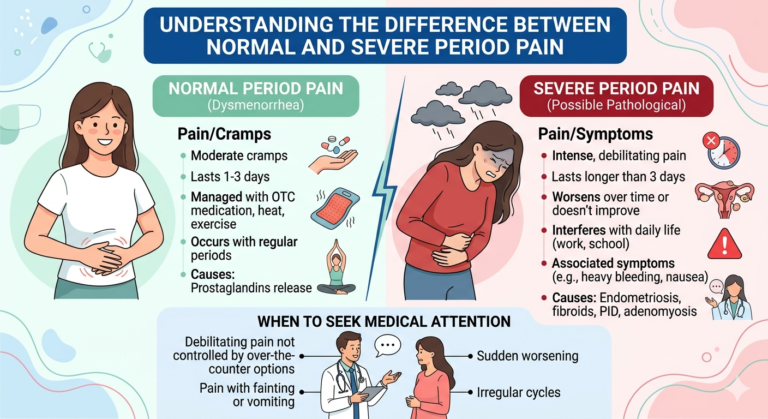
First, a quick biology lesson. When you menstruate, your uterus contracts to shed its lining. These contractions are triggered by chemicals called prostaglandins. Higher levels of prostaglandins mean stronger contractions and more pain. That is why the first day or two of your period often hurts the most – that is when prostaglandin levels peak.

Normal period pain comes from these natural contractions. Severe period pain usually means something else is going on. The contractions are either too strong, or there is an underlying condition making normal contractions feel unbearable.

What Normal Period Pain Feels Like

Let me describe what is considered normal so you have a baseline. Normal period pain is mild to moderate. You feel it in your lower belly, sometimes spreading to your lower back or inner thighs. It comes and goes in a cramping, wave-like pattern. It usually starts just before or at the beginning of your period and lasts for one to two days.

Most importantly, normal pain responds to simple measures. An over-the-counter painkiller like ibuprofen or naproxen usually helps. A hot water bottle or heating pad provides relief. You might slow down a little, but you can still go to work, attend classes, and do most of your daily activities. You do not need to cancel plans or stay in bed all day.

What Severe Period Pain Feels Like

Now let me describe what is not normal. Severe period pain is intense. It is often described as stabbing, knifelike, or “like someone is wringing out my insides.” It may be constant rather than wave-like, or the waves are so strong that you cannot function between them.

The key difference is how it affects your life. If you regularly miss school or work because of your period, that is not normal. If you spend your period curled up in bed, unable to move, vomiting or feeling faint – that is not normal. If over-the-counter painkillers do nothing, or only take the edge off for an hour, that is not normal. And if the pain starts several days before your period or continues for several days after it ends, that is a red flag.

The Clot Test

Here is a simple way to check in with yourself. Small clots, the size of a raisin or a small grape, are normal. They happen when your flow is heavy and natural anticoagulants in your uterus get overwhelmed. But clots larger than a one-rupee coin, especially if they come with severe pain, suggest something like fibroids or a hormonal imbalance. Passing large clots repeatedly is a sign to see a doctor.

Conditions That Cause Severe Period Pain

If your pain crosses the line from normal to severe, there is usually a specific reason. The most common is endometriosis. That is when the tissue that normally lines your uterus grows outside it – on your ovaries, fallopian tubes, or pelvic lining. Every month, that tissue bleeds just like your uterine lining, but the blood has nowhere to go. It causes inflammation, scarring, and intense pain that often starts before your period and lasts after it ends.

Uterine fibroids are another common cause. These non-cancerous growths in the uterine muscle can make contractions much more forceful. They often cause heavy bleeding with large clots along with the pain.

Adenomyosis is similar to endometriosis but inside the uterine wall itself. The lining grows into the muscle, making the uterus boggy and tender. The pain is often a deep, heavy, “bearing down” sensation.

Pelvic inflammatory disease (PID), usually from an untreated infection, can cause chronic pelvic pain that gets much worse during your period. And in some cases, a condition called ovarian cysts – especially if a cyst ruptures or twists – can cause sudden, severe pain that may be mistaken for severe menstrual cramps.

When to Stop Ignoring the Pain

Here is my simple rule. If your period pain regularly interferes with your life for more than one day each cycle, you should see a doctor. If you have to take sick leave every month, that is not “just how periods are.” That is a medical problem that deserves attention.

Also see a doctor if the pattern of your pain changes. If your periods were manageable and suddenly become much more painful, something has changed. If you start having pain between periods, during sex, or with bowel movements, those are additional clues pointing to endometriosis or another condition.

What a Gynecologist Will Do

When you see a gynecologist in malviya nagar delhi, they will start by asking you very specific questions about your pain. When does it start? How long does it last? What makes it better or worse? Do painkillers help? How much do you bleed? Do you pass clots?

They will do a pelvic exam to check for tenderness, masses, or abnormalities. They will almost certainly order an ultrasound to look for fibroids, ovarian cysts, or signs of adenomyosis. Ultrasound cannot always rule out endometriosis – that sometimes requires a laparoscopy, a minor surgery where a camera is inserted into your abdomen.

For ongoing or complex cases, finding the best gynecologist in malviya nagar delhi ensures you get a thorough evaluation. Some gynecologists are dismissive of period pain. The best ones take it seriously, run the right tests, and offer real treatment options – not just “learn to live with it.”

Treatment Options That Actually Work

The good news is that severe period pain is treatable. For mild to moderate cases, hormonal birth control – pills, patch, ring, or IUD – is often the first line. It thins the uterine lining and reduces prostaglandins, which means lighter, less painful periods.

For women who cannot or do not want to use hormones, non-hormonal medications like tranexamic acid or high-dose NSAIDs (prescription strength ibuprofen or naproxen) can help. For fibroids, options range from medication to shrink them, to uterine artery embolisation, to surgical removal (myomectomy). For endometriosis, hormonal suppression or laparoscopic surgery to remove the misplaced tissue can provide dramatic relief.

In severe cases where no other treatment works and childbearing is complete, a hysterectomy (removal of the uterus) may be considered – but only as a last resort after everything else has failed.

A Final Word from a Guide’s Desk

Here is what I want you to remember. Pain is not a competition. You do not get a medal for suffering through terrible periods. Normal discomfort is one thing. Pain that controls your life is another. If you have been told by your mother, your friends, or even a doctor that your pain is normal and you just need to deal with it, get a second opinion. You know your body better than anyone. If it feels wrong, it probably is. And there is help. You just have to ask for it.

read more on healthymostly.com