
Introduction to HACCP Certification in Farming
HACCP certification provides a systematic approach to identifying, evaluating, and controlling food safety hazards across the production process. For farms, this certification establishes a formal framework that ensures agricultural products are cultivated, handled, and stored under controlled conditions that minimize contamination risks. Unlike informal safety practices, HACCP certification brings consistency, accountability, and traceability into farm operations.
Farms operate in dynamic environments shaped by variables such as soil, water, climate, and biological activity. As a result, these conditions increase exposure to potential hazards. HACCP certification addresses these risks through a structured system, ensuring food safety from the earliest stages of production. Moreover, as global food supply chains continue to expand, farms increasingly require verifiable safety systems, making HACCP certification essential for operations of all sizes.
The Concept and Scope of HACCP Certification
HACCP certification follows a preventive methodology rather than a reactive one. Instead of relying on end-product inspection, the system focuses on identifying risks during production and implementing controls to prevent hazards before they occur. In farming, this approach includes monitoring agricultural inputs, environmental conditions, and operational practices.
Furthermore, the scope of HACCP certification in farming covers multiple stages, including land preparation, planting, irrigation, harvesting, handling, and storage. Each stage presents distinct risks that require systematic evaluation. Therefore, the certification promotes a proactive approach to food safety, reducing contamination risks while improving overall product quality.
Relevance of HACCP Certification for Farm Operations
Farms serve as the primary source of raw food materials entering the supply chain. Consequently, any lapse in safety at this stage can create widespread consequences. HACCP certification ensures that farms implement structured controls to address biological, chemical, and physical hazards effectively.
For instance, biological hazards may arise from microbial contamination through water or animal intrusion. Similarly, chemical hazards often result from improper use of fertilizers or pesticides, while physical hazards may involve foreign objects introduced during harvesting or handling. By identifying these risks and applying preventive measures, farms strengthen food safety and operational discipline. In addition, this structured approach supports better decision-making and reduces variability in production outcomes.
Hazard Identification in Agricultural Environments
Hazard identification forms a critical component of HACCP certification. Farms must assess risks associated with their environment and operational practices. This process involves evaluating inputs such as water sources, soil quality, fertilizers, and equipment.
For example, irrigation water often presents a major concern, as contaminated water can introduce pathogens into crops. Therefore, farms must monitor water quality regularly. Likewise, soil conditions and previous land use require careful evaluation to detect potential contamination sources. Equipment used during planting and harvesting also demands proper maintenance and cleanliness.
By documenting identified hazards and assessing their significance, farms establish a strong foundation for effective control measures.
Establishing Critical Control Points in Farming
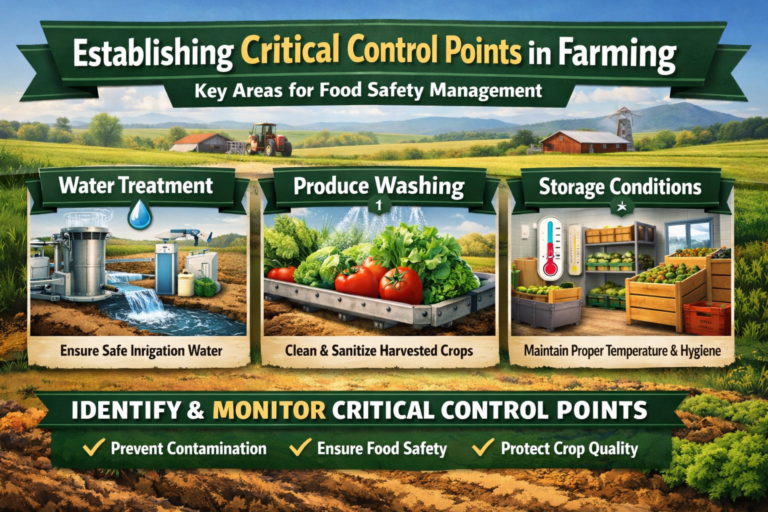
Critical Control Points (CCPs) represent stages where farms can apply controls to prevent or reduce hazards to acceptable levels. In farming operations, CCPs commonly include water treatment, produce washing, and storage conditions.
To identify CCPs accurately, farms must analyze each step of the production process. For instance, if irrigation water poses a contamination risk, treatment or testing becomes essential. Similarly, post-harvest handling areas require strict hygiene controls.
As a result, clearly defined CCPs, combined with effective monitoring systems, enable farms to maintain consistent food safety standards.
Monitoring and Control Measures
Monitoring ensures that CCPs remain within defined safety limits. HACCP certification requires farms to establish practical and consistent monitoring procedures.
Typically, monitoring activities include water quality testing, storage inspections, and equipment cleanliness checks. Farms must perform these activities at defined intervals and maintain accurate records. Consequently, early detection of deviations allows farms to take timely corrective action before risks escalate.
Importantly, control measures should remain practical and aligned with farm operations. HACCP certification emphasizes efficiency without unnecessary complexity.
Corrective Actions and Preventive Measures
When deviations occur, farms must implement corrective actions immediately. HACCP certification requires clear procedures to address non-conformities. These actions may include isolating affected produce, adjusting processes, or improving sanitation practices.
At the same time, preventive measures play an equally important role. Farms must analyze root causes and implement changes to prevent recurrence. Therefore, this continuous improvement cycle strengthens the effectiveness of the HACCP system over time.
Documentation and Record Management
Documentation serves as a fundamental requirement of HACCP certification. Farms must maintain records that demonstrate compliance with established procedures and controls. These records provide evidence of monitoring activities, corrective actions, and system verification.
However, effective documentation does not require complex systems. Simple logs, checklists, and records remain sufficient when maintained accurately and consistently. As a result, proper record management enhances traceability, supports performance tracking, and enables timely responses to potential issues.
Role of Personnel and Training in HACCP Certification
Personnel play a central role in successful HACCP implementation. Farm workers must understand food safety principles and their responsibilities within the system.
Training programs should cover hygiene practices, hazard awareness, and monitoring procedures. In addition, workers must learn to identify risks and respond appropriately. Clear communication and supervision further ensure consistent adherence to procedures.
Ultimately, a well-trained workforce strengthens the reliability and effectiveness of the HACCP system.
Adapting HACCP Certification to Seasonal Variations
Seasonal changes significantly influence farming operations. Therefore, HACCP certification requires farms to adjust control measures according to environmental conditions.
For example, increased rainfall may elevate water contamination risks, while high temperatures can affect storage stability. Similarly, pest activity often varies with seasons, introducing additional hazards.
By regularly reviewing and updating HACCP plans, farms ensure that control measures remain effective throughout different production cycles.
Common Challenges in Implementing HACCP Certification
Farms often face challenges during HACCP implementation, including limited resources, lack of technical knowledge, and resistance to change.
In many cases, overcomplicating the system creates difficulties in maintenance. On the other hand, insufficient documentation leads to gaps in traceability. Therefore, farms must adopt a balanced approach that combines simplicity with effectiveness.
Through proper training, guidance, and gradual implementation, farms can overcome these challenges successfully.
Benefits of HACCP Certification for Farms
HACCP certification offers multiple benefits beyond regulatory compliance. First, it enhances food safety by reducing contamination risks and improving process control. Additionally, certified farms gain better access to markets that require verified safety standards.
Moreover, buyers and stakeholders show greater confidence in products produced under controlled conditions. At the same time, farms benefit from improved operational efficiency, reduced losses, and increased consistency.
Certification Process with Integrated Assessment Service
Integrated Assessment Service provides HACCP certification tailored to farm operations. The certification process includes an initial assessment, documentation review, and on-site audit to evaluate compliance with HACCP requirements.
Furthermore, the approach emphasizes practicality, ensuring alignment with the farm’s specific conditions and processes. The service also offers guidance to support implementation and address identified gaps.
As a result, farms achieve recognized food safety standards while maintaining operational feasibility.
Conclusion
HACCP certification provides a structured and effective framework for managing food safety risks in farming. By focusing on hazard identification, control measures, and continuous monitoring, farms maintain high standards of safety and quality.
Although implementation requires commitment, training, and consistency, the long-term benefits outweigh the effort. Improved safety, enhanced market access, and operational stability make HACCP certification a valuable investment.
Ultimately, through a disciplined and systematic approach, farms can produce safe, reliable, and high-quality agricultural products.