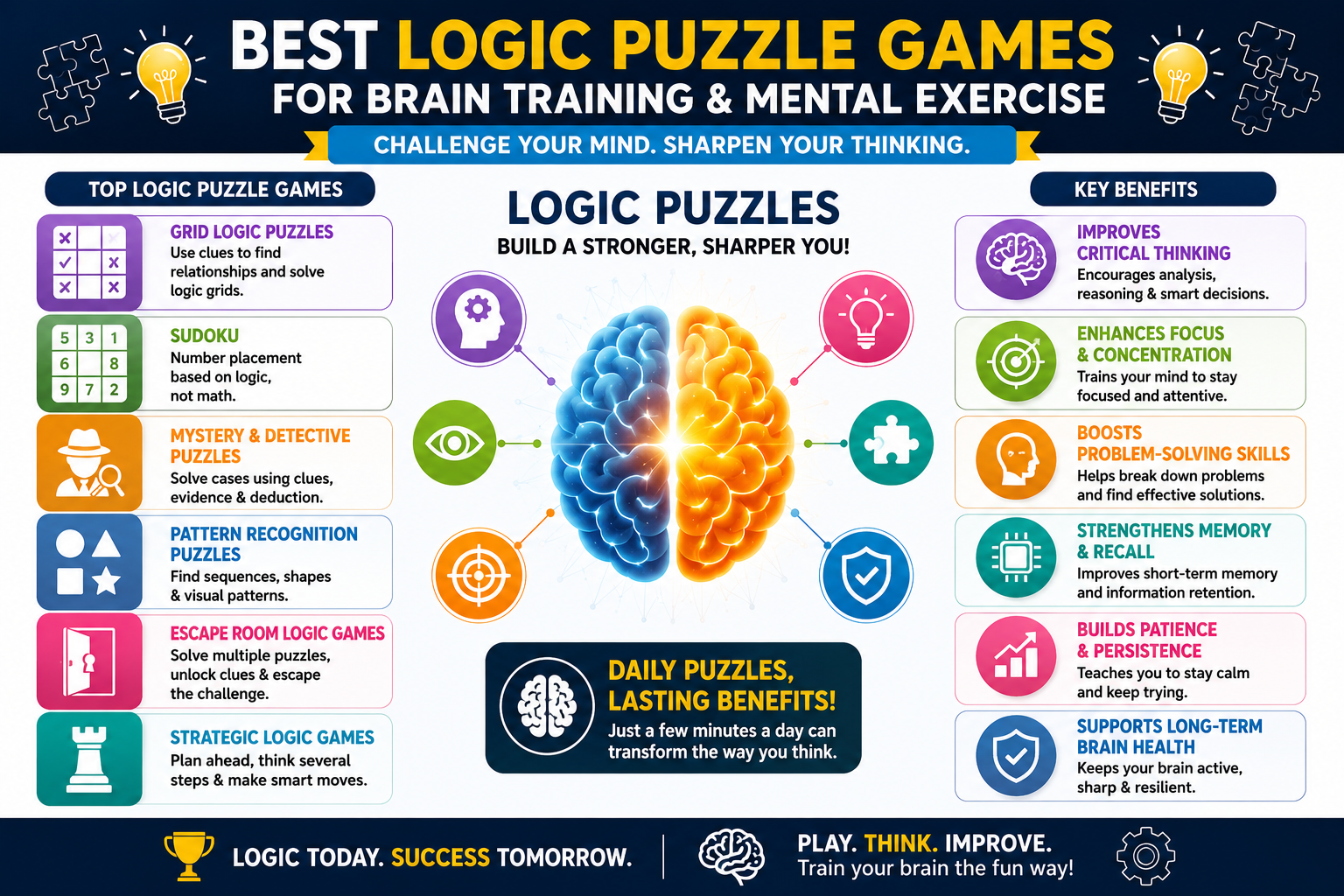
Most people think of exercise as something that keeps the body healthy. The brain, however, also benefits from regular challenges. Just like muscles become stronger through consistent activity, the mind performs better when it is pushed to think, analyze, and solve problems. This is one reason logic puzzle games have remained popular for generations.
Unlike many forms of entertainment that involve passive consumption, logic puzzles require active participation. They encourage players to examine information carefully, recognize patterns, and reach conclusions based on reasoning rather than guesswork. Whether you are a student looking to sharpen your thinking skills, a professional seeking a productive mental break, or simply someone who enjoys intellectual challenges, logic puzzle games can provide both enjoyment and valuable cognitive benefits.
Why Logic Puzzle Games Are More Than Just a Hobby
Many people start solving logic puzzles simply because they are fun. Over time, however, they often notice something else. The process of working through clues, eliminating incorrect options, and finding solutions begins to feel like a mental workout.
A well-designed logic puzzle does not reward random answers. Instead, it requires patience, observation, and structured thinking. Every decision influences the next step, forcing the brain to stay engaged throughout the challenge.
This is why logic puzzles are frequently included in discussions about brain training activities, critical thinking exercises, and mental fitness routines.
Grid Logic Puzzles: A Test of Reasoning Skills
Among the most respected logic games are grid-based puzzles. These challenges usually provide a set of clues that must be connected logically to uncover a final answer.
At first, the clues may seem unrelated. One clue might mention a person’s favorite color, while another references a pet or occupation. The challenge lies in organizing the information and identifying relationships between different pieces of evidence.
What makes these puzzles so rewarding is that success depends entirely on logical reasoning. Players learn to evaluate possibilities carefully instead of making assumptions. Over time, this habit of structured thinking can influence how people approach real-world decisions and problem-solving situations.
Sudoku: The Logic Puzzle Loved Worldwide
Although Sudoku uses numbers, it is not a mathematics game. Many beginners are surprised to learn that solving Sudoku requires logic rather than calculation.
The puzzle challenges players to analyze existing information and determine where numbers belong based on a set of rules. As the grid becomes more complex, concentration and careful observation become increasingly important.
One reason Sudoku remains one of the best logic puzzle games for brain training is that it exercises multiple cognitive skills at once. Players must remain focused, track possibilities, and adapt their strategy as new information becomes available.
Mystery and Detective Logic Games
Some of the most engaging logic puzzles place players in the role of an investigator.
These games often involve solving a mystery using clues, evidence, and deduction. Instead of relying on luck, players must analyze information carefully and eliminate impossible scenarios until the correct solution emerges.
Many puzzle enthusiasts enjoy detective-style challenges because they create a sense of progression. Each clue feels meaningful, and every correct deduction brings the player closer to solving the mystery.
This type of puzzle encourages analytical thinking while making the experience feel immersive and rewarding.
Pattern Recognition Challenges
Pattern recognition is a skill people use every day, often without realizing it. Recognizing trends, identifying similarities, and spotting irregularities all involve pattern analysis.
Logic puzzle games built around sequences, shapes, symbols, and visual arrangements help strengthen this ability. The brain learns to process information more efficiently by identifying relationships that may not be immediately obvious.
For students, professionals, and lifelong learners, strong pattern recognition skills can be valuable in both academic and practical situations.
Escape Room Logic Experiences
The popularity of digital escape rooms has introduced many players to a new form of logic-based entertainment.
These challenges combine multiple puzzle types into a single experience. Players may need to solve riddles, uncover hidden clues, interpret symbols, and connect information from different sources to advance.
What makes escape room games unique is their ability to test several cognitive skills simultaneously. Memory, reasoning, observation, and decision-making all work together as players progress through increasingly complex scenarios.
For people seeking a more immersive mental challenge, escape room puzzles offer an excellent balance of entertainment and brain training.
Strategic Logic Games
Some logic games focus on long-term planning rather than immediate solutions.
These puzzles require players to think ahead, evaluate potential outcomes, and adapt when circumstances change. Success often depends on anticipating future possibilities rather than reacting to the present situation alone.
Games that involve strategic logic help develop decision-making skills and encourage deeper analytical thinking. They can also improve patience, as rushing through a challenge often leads to mistakes.
This makes strategy-based puzzles particularly appealing for players who enjoy thoughtful and calculated problem-solving.
The Long-Term Benefits of Logic Puzzle Games
The greatest advantage of logic puzzles is that their benefits extend beyond the game itself.
Regular puzzle-solving encourages habits that are useful in everyday life. People become more comfortable analyzing information, identifying patterns, and approaching problems systematically. These skills can support learning, workplace productivity, and personal decision-making.
Many individuals who regularly solve logic puzzle games online report that they enjoy the sense of mental engagement these challenges provide. Instead of scrolling through content passively, they spend time actively exercising their minds.
Finding the Right Puzzle for You
Not every logic puzzle appeals to every player. Some people enjoy deduction-based mysteries, while others prefer number puzzles, pattern challenges, or strategic reasoning games.
The best approach is to explore different puzzle styles and discover which ones keep you engaged. A puzzle that feels enjoyable is far more likely to become a consistent habit.
Even spending a few minutes each day solving logic puzzles can provide meaningful mental stimulation over time.
Conclusion
The best logic puzzle games do more than entertain. They encourage critical thinking, strengthen reasoning skills, improve concentration, and provide valuable mental exercise. From Sudoku and detective mysteries to pattern-recognition challenges and strategic reasoning games, each puzzle offers a unique way to keep the brain active.In a world where distractions are everywhere, taking time to solve a logic puzzle can be a refreshing way to challenge your mind. Whether you are looking to improve problem-solving abilities, enhance logical reasoning, or simply enjoy a rewarding mental workout, logic puzzle games remain one of the most effective and enjoyable tools for brain training.