
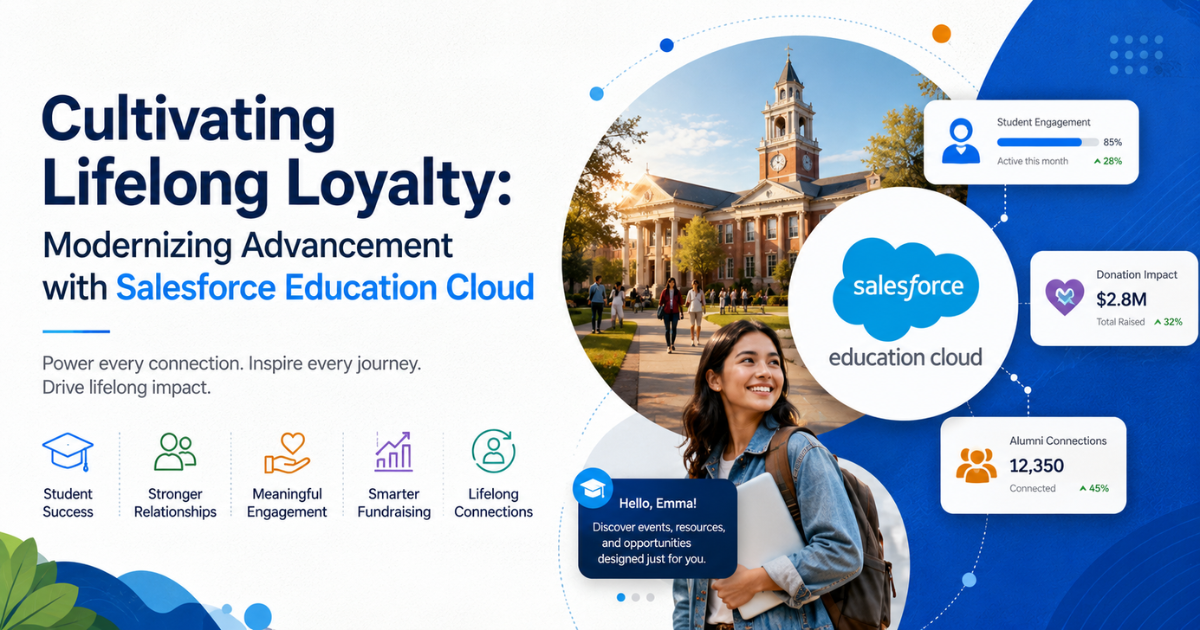
Higher education faces a shifting landscape. Traditional fundraising methods often fail to engage younger alumni. Institutions now require a sophisticated digital strategy to maintain donor interest. Salesforce Education Cloud offers a robust framework for this transformation. It moves advancement offices away from static databases. Instead, it creates a dynamic ecosystem for engagement. Many universities use Salesforce Education Cloud Consulting to build these complex systems.
The Problem with Legacy Advancement Systems
Many universities still use decades-old databases. These systems act as simple electronic filing cabinets. They store names and addresses but lack behavioral context. This leads to “generic” outreach. Generic emails often result in low engagement.
Statistics show that donor retention rates in higher education hover around 43%. This means schools lose more than half of their donors every year. Furthermore, 75% of young alumni say they would give more if they felt a personal connection to the cause. Salesforce Education Cloud Consulting Services help institutions bridge this gap. They replace isolated data with a unified view of the constituent.
A Unified Data Architecture for Donors
The foundation of modern advancement is a single source of truth. In the past, student data lived in the Student Information System (SIS). Alumni data lived in a separate CRM. These two worlds rarely spoke to each other.
Transitioning from Student to Alumni
The transition phase is critical. Salesforce Education Cloud uses a common data model. This allows for a seamless handoff. When a student graduates, their record updates automatically. Their academic interests, campus involvement, and career goals follow them into the alumni database.
- Affiliation Mapping: The system tracks every club, sports team, and department a student joined.
- Relationship Intelligence: It maps connections between alumni. This helps identify “hidden” networks for major gift prospecting.
- Life Events: The platform records marriages, job changes, and births. This data allows for timely, personal outreach.
Technical Strategies for Precision Fundraising
Fundraising is no longer just about phone calls. It is about data science. Modern advancement teams use technical tools to predict who will give and when.
1. Predictive Scoring with Einstein AI
AI plays a vital role in prioritizing prospects. Einstein AI analyzes thousands of data points. It identifies patterns that humans might miss.
- Likelihood to Give: The system scores donors based on past frequency and wealth indicators.
- Churn Prediction: It flags donors who might stop giving. This allows staff to intervene early.
- Engagement Scoring: It measures how often an alumnus opens emails or visits the campus.
High engagement scores often correlate with future donations. In fact, schools using AI for prospecting see a 10% to 15% increase in gift officer productivity. They spend less time searching and more time building relationships.
2. Gift and Pledge Management
Managing complex gifts requires technical precision. Salesforce Education Cloud automates the gift entry process. It handles various gift types:
- Recurring Gifts: Automated monthly or yearly contributions.
- Matching Gifts: Integration with corporate databases to double donor impact.
- Pledges: Tracking long-term commitments against actual payments.
This automation reduces manual entry errors. It also ensures donors receive tax receipts instantly. Speed in communication builds trust. Trust is the primary driver of loyalty.
Personalized Communication at Scale
Personalization is hard to achieve with 100,000 alumni. However, the right technology makes it possible. Salesforce Education Cloud Consulting Services often include setting up Marketing Cloud or Account Engagement.
1. Dynamic Content and Segmentation
Don’t send a generic newsletter. Use the data in Salesforce to change the content for every reader.
- Segment by Major: Send engineering news to engineers.
- Segment by Location: Invite alumni in Chicago to a local networking event.
- Segment by Interest: Send updates about the basketball team to former student-athletes.
Technical teams use AMPScript to pull these attributes into emails. This ensures the message feels personal. Personalization increases email click-through rates by up to 14%. It also reduces unsubscribe rates significantly.
2. Multi-Channel Journeys
An “Advancement Journey” is a series of automated touchpoints. For example, a “New Graduate Journey” might look like this:
- Month 1: A “Welcome to the Alumni Association” email.
- Month 3: A request to update their current job title.
- Month 6: An invitation to mentor a current student.
- Month 12: A small request for a first-time donation.
This slow build-up prevents “ask fatigue.” It shows the alumnus that the school cares about their success, not just their money.
Leveraging Data Cloud for Advancement
The newest frontier in advancement is Data Cloud. This platform allows for real-time data ingestion. It can pull data from the university website, social media, and third-party wealth screens.
Salesforce Education Cloud Consulting teams use Data Cloud to create “Unified Individual” records. This process resolves identities. It knows that “Bob Smith” on LinkedIn is the same “Robert Smith” in the alumni database.
- Real-Time Engagement: If a major donor visits the “Planned Giving” page on your website, a notification goes to their gift officer.
- Social Listening: Track what alumni say about the university on public forums.
- High-Volume Processing: Handle millions of records without slowing down the core CRM.
Data Cloud ensures that your information is never more than a few seconds old. This agility is essential for modern fundraising.
Improving the Alumni Experience
Loyalty is a two-way street. The university must provide value to its graduates. Salesforce Education Cloud powers digital portals. These portals serve as a “Digital Home” for alumni.
Self-Service Portals
Alumni can log in to a secure portal built on Experience Cloud. Here, they can perform several tasks:
- Update Contact Info: Keeps your database clean without manual work.
- Access Benefits: Download digital alumni cards or access library resources.
- Networking: Find other alumni in their city or industry.
- Giving History: View their lifetime contributions and download tax documents.
These portals reduce the administrative burden on university staff. They also put the alumnus in control of their relationship with the school.
Managing Grants and Strategic Partnerships
Many advancement offices also manage corporate relations and grants. This requires a different set of tools. Salesforce Education Cloud handles “Institutional Giving” alongside individual giving.
- Grant Tracking: Manage the entire lifecycle of a grant. This includes the application, the award, and the reporting requirements.
- Corporate Partnerships: Track which companies hire the most graduates. Use this data to ask for sponsorship or research funding.
- Event Management: Coordinate galas, reunions, and homecoming. The system tracks attendance and calculates the ROI of every event.
Strategic partnerships often provide a steady stream of revenue. Using a single platform for both individuals and corporations provides a holistic view of institutional support.
The Role of Managed Services
Building these systems is only the first step. Technology evolves quickly. Many schools invest in ongoing Salesforce Education Cloud Consulting Services. These services ensure the platform stays optimized.
- Release Management: Salesforce updates the platform three times a year. Managed services teams test these updates to ensure nothing breaks.
- Data Cleansing: Continuous “De-duplication” keeps the database accurate.
- User Training: Teaching staff how to use new AI features or reporting tools.
- Custom Development: Building specific tools for unique university needs.
Professional guidance prevents the platform from becoming “shelfware.” It ensures the institution maximizes its investment every year.
Technical Security and Compliance
Data privacy is a major concern for advancement offices. They handle sensitive financial and personal data. Salesforce Education Cloud provides enterprise-grade security features.
- Shield Encryption: Protects data at rest and in transit.
- Event Monitoring: Tracks who accessed which records and when.
- Compliance Tools: Helps schools follow GDPR, CCPA, and other privacy laws.
Maintaining a secure system is essential for donor trust. A single data breach can destroy decades of goodwill. Technical teams must configure these security settings correctly from day one.
Overcoming Internal Resistance
The biggest challenge is often cultural, not technical. Staff may fear that AI will replace them. Or, they may prefer their old spreadsheets.
To succeed, focus on “Value-Based Outcomes.” Show the gift officers how the system saves them time. Demonstrate how the data helps them close larger gifts.
“Technology does not replace the gift officer. It makes them more human by removing the administrative noise.”
Start with a “Pilot Program.” Pick one department and move them to the new system. Once they see success, other departments will follow. This phased approach reduces risk and builds internal support.
Conclusion
Modernizing advancement is a technical necessity. To cultivate lifelong loyalty, universities must act like modern digital enterprises. Salesforce Education Cloud provides the engine for this change.
By leveraging Salesforce Education Cloud Consulting, institutions can build a scalable data architecture. They can use AI to find the right donors. They can use automation to deliver personal messages to thousands of people.
The goal is to move from “transact” to “transform.” Don’t just ask for a check once a year. Build a lifelong relationship that starts on the first day of classes. With the right technology, every alumnus can feel like the most important person on campus. This is the architecture of loyalty in the digital age.
