
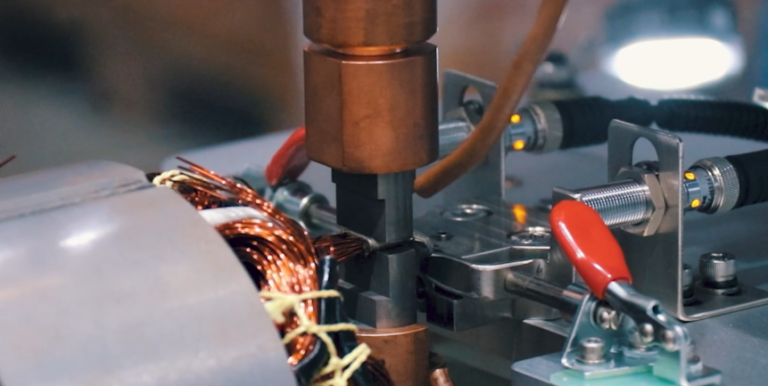
In high-volume manufacturing environments, fastening reliability, production speed, and automation compatibility are critical factors that determine product quality and operational efficiency. Among the various resistance welding solutions used in industrial fabrication, the nut welder plays a vital role in securely attaching threaded fasteners to sheet metal components without mechanical drilling or manual fastening.
For OEMs, automotive suppliers, appliance manufacturers, and metal fabrication plants, nut welding technology provides a fast, clean, and repeatable method of creating strong threaded joints suitable for automated production lines.
This article explains how nut welders work, their types, industrial applications, benefits, and best practices for achieving consistent weld quality in modern production systems.
What Is a Nut Welder?
A nut welder is a specialized resistance welding machine designed to weld threaded nuts onto metal sheets using controlled electrical current and pressure. The process forms a metallurgical bond between the nut and base material, eliminating the need for mechanical fastening methods such as rivets, screws, or adhesives.
Unlike conventional fastening, nut welding ensures:
- Permanent and vibration-resistant joints
- High-speed automated assembly
- Reduced component handling
- Consistent weld strength across production batches
Nut welders are widely integrated into automated manufacturing lines where precision and repeatability are essential.
How Nut Welding Works: The Core Principle
Nut welding is based on the principles of resistance welding, where heat is generated by electrical resistance at the contact interface.
Basic Working Process:
- The nut is positioned on the metal sheet using a welding electrode or positioning system.
- A controlled force is applied to ensure tight contact.
- High electrical current is passed through the nut and sheet metal.
- Resistance at the interface generates localized heat.
- The material reaches a plastic or molten state at the contact point.
- Pressure is maintained until solidification occurs, forming a strong weld joint.
This process ensures that the nut becomes permanently fused to the base material without compromising thread integrity.
Types of Nut Welding Systems
Different production environments require different nut welding technologies depending on material type, production speed, and automation level.
1. Projection Nut Welders
Projection nut welding uses pre-formed projections on the nut surface to concentrate heat during welding. This ensures controlled energy distribution and consistent weld quality.
Common applications:
- Automotive body panels
- Electrical enclosures
- Sheet metal assemblies
2. Capacitor Discharge (CD) Nut Welders
Capacitor discharge systems store electrical energy and release it rapidly for instant welding. This method is ideal for thin sheets and precision applications.
Advantages:
- Minimal heat distortion
- High-speed welding cycle
- Clean surface finish
3. MFDC Nut Welding Systems
Medium Frequency Direct Current (MFDC) nut welders provide stable energy control and high efficiency, making them suitable for modern automated production lines.
Benefits:
- Lower energy consumption
- Improved weld consistency
- Reduced electrode wear
4. Automated Nut Welding Stations
These systems integrate robotic arms, positioning units, and controllers to achieve fully automated welding operations.
Used in:
- Automotive assembly lines
- EV battery enclosures
- Industrial machinery manufacturing
Key Applications of Nut Welding in Industry
Nut welders are essential in industries where threaded joints must withstand mechanical stress, vibration, and long-term usage.
Automotive Manufacturing
Nut welding is widely used for chassis assembly, seat frames, engine compartments, and structural components where strong fastening is required without adding extra hardware.
Electrical Equipment Production
Control panels, switchgear cabinets, and industrial enclosures use nut welding to ensure secure mounting points for components.
HVAC and Appliance Manufacturing
From air conditioning units to washing machines, nut welders provide fast and durable fastening solutions for sheet metal assemblies.
Industrial Machinery
Heavy-duty equipment requires vibration-resistant fasteners, making nut welding a preferred solution for structural integrity.
EV and Battery Systems
Electric vehicle platforms rely heavily on nut welding for battery housings, lightweight structures, and precision assemblies.
Advantages of Using Nut Welding Technology
Manufacturers choose nut welding systems due to their efficiency, reliability, and automation compatibility.
High Production Efficiency
Nut welders significantly reduce assembly time compared to manual fastening methods.
Strong Mechanical Performance
Welded joints offer excellent resistance to vibration, torque, and mechanical stress.
Reduced Manufacturing Costs
Eliminates the need for additional hardware like bolts, washers, or adhesives.
Automation Compatibility
Easily integrated into robotic production lines and CNC-controlled systems.
Clean and Consistent Finish
No drilling or surface damage, resulting in improved product aesthetics and quality consistency.
Nut Welding vs Traditional Fastening Methods
Understanding the difference between nut welding and conventional fastening helps manufacturers choose the right solution.
| Feature | Nut Welding | Mechanical Fastening |
|---|---|---|
| Strength | High metallurgical bond | Depends on torque |
| Speed | Very fast in automation | Slower, manual effort |
| Cost Efficiency | Low long-term cost | Higher labor cost |
| Automation | Fully compatible | Limited |
| Surface Damage | None | Requires drilling |
Nut welding clearly outperforms traditional fastening in high-volume industrial production environments.
Best Practices for High-Quality Nut Welding
To achieve consistent and reliable results, manufacturers should follow these technical guidelines:
1. Proper Surface Preparation
Ensure that metal surfaces are clean and free from oil, rust, or coatings that can affect conductivity.
2. Correct Electrode Alignment
Misalignment can cause uneven heat distribution and weak welds.
3. Optimized Welding Parameters
Control current, pressure, and welding time based on material thickness and nut size.
4. Regular Electrode Maintenance
Worn electrodes reduce weld quality and increase resistance inconsistencies.
5. Material Compatibility
Select appropriate nut and sheet metal combinations for optimal bonding performance.
Common Challenges in Nut Welding
Even advanced systems may face operational challenges if not properly configured.
- Inconsistent weld strength due to incorrect parameters
- Electrode wear affecting production quality
- Material deformation in thin sheets
- Misalignment in automated feeding systems
These issues can be minimized through proper machine calibration and the use of advanced welding controllers.
Why Nut Welders Are Critical for Smart Manufacturing
As industries move toward Industry 4.0, nut welders are becoming essential components of smart factories. Their ability to integrate with robotic systems, sensors, and real-time monitoring tools makes them ideal for modern production environments.
Key trends include:
- AI-based weld monitoring
- Real-time quality control systems
- Fully automated robotic welding cells
- Energy-efficient MFDC systems
These advancements are pushing nut welding technology toward higher precision, lower cost, and improved scalability.
FAQs About Nut Welders
1. What materials can be used with nut welders?
Nut welders are commonly used with low-carbon steel, stainless steel, and coated sheet metals depending on machine configuration.
2. Is nut welding stronger than traditional screw fastening?
Yes, nut welding creates a permanent metallurgical bond that is more resistant to vibration and loosening compared to mechanical fasteners.
3. Can nut welding be fully automated?
Yes, modern nut welding systems are widely used in robotic and CNC-controlled production lines for high-volume manufacturing.
4. What industries use nut welding the most?
Automotive, electrical equipment, HVAC, appliance manufacturing, and EV production are the primary industries using nut welding technology.
5. How do I improve nut welding quality?
Proper surface preparation, correct parameter settings, and regular maintenance of electrodes are key factors for consistent weld quality.
Conclusion
Nut welding has become an essential joining technology in modern industrial manufacturing due to its strength, speed, and automation compatibility. From automotive assembly lines to electrical enclosures and heavy machinery, nut welders ensure reliable threaded connections that meet high-performance engineering standards.
As manufacturing continues to evolve toward smart, automated production systems, nut welding technology will play an even more important role in improving efficiency and reducing production costs.
Request a Custom Nut Welding Solution
For manufacturers looking to improve production efficiency and welding quality, advanced nut welding systems offer a scalable and cost-effective solution. Custom configurations, automated integration, and application-specific designs can significantly enhance output performance and product reliability.
Contact a professional welding automation provider to explore tailored nut welding solutions for your production line and optimize your manufacturing process for the future.