
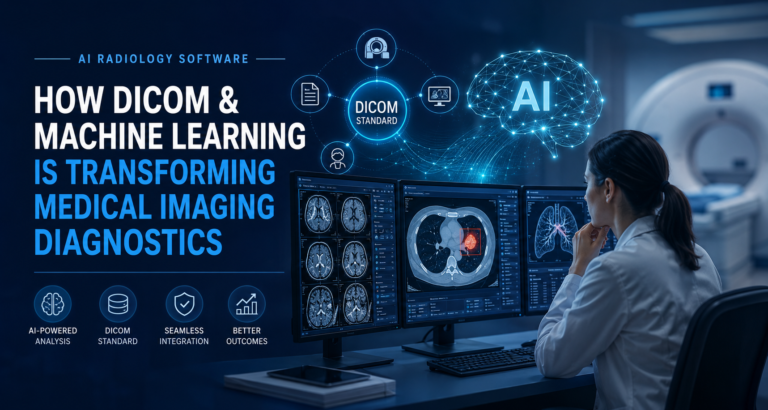
Every day, radiologists around the world review thousands of scans — chest X-rays, brain MRIs, CT images — searching for the subtle shadows and shapes that could signal cancer, stroke, or disease. AI Radiology Software It’s painstaking, high-stakes work. And now, artificial intelligence is stepping in as a powerful co-pilot. At the heart of this transformation lies a combination that might not sound glamorous but is genuinely revolutionary: DICOM standards and machine learning algorithms working in tandem.
Here’s what that means, why it matters, and what it means for the future of your healthcare.
What Is DICOM, and Why Does It Matter?
Before we talk about AI, we need to talk about the language medical images speak.
DICOM — short for Digital Imaging and Communications in Medicine — is the universal standard format for storing, transmitting, and displaying medical imaging data. Think of it as the PDF of the medical world, except far more sophisticated. Every MRI scan, CT slice, ultrasound, and digital X-ray is stored as a DICOM Viewer file, and that file carries far more than just pixels. It contains embedded metadata: patient demographics, acquisition settings, scanner model, imaging protocol, and clinical context — all packaged together.
This standardization was a landmark achievement in healthcare interoperability. Before DICOM, medical images were trapped in proprietary systems, impossible to share between hospitals or vendors. Today, a scan taken in one country can be read by software or a specialist anywhere in the world.
But DICOM’s real power in the modern era is what it enables for AI: a structured, rich, consistent data format that machine learning models can actually learn from.
Where Machine Learning Enters the Picture
Machine learning – and more specifically, deep learning using convolutional neural networks (CNNs) – has proven extraordinarily effective at analyzing visual patterns in images. These are the same underlying techniques that power facial recognition and self-driving car vision systems. Applied to DICOM images, they can identify patterns that are invisible to the naked eye, consistent in ways no human can be, and fast in ways no human ever could be.
Here’s what that looks like in practice:
1. Automated Anomaly Detection
AI models trained on millions of labeled DICOM scans can flag potential abnormalities — a pulmonary nodule on a chest CT, a hemorrhage on a brain scan, a fracture on an X-ray — often in seconds. The software doesn’t replace the radiologist; it acts as a first-pass filter, prioritizing urgent cases and surfacing the findings that need immediate human attention.
This is particularly transformative in high-volume emergency settings, where a radiologist might have hundreds of scans queued. An AI triage system ensures the stroke patient’s scan isn’t buried behind routine follow-ups.
2. Quantitative Measurement and Segmentation
Traditional radiology relies heavily on qualitative assessment — a radiologist describes what they see. AI enables precise quantification. Tumor volume measured to the millimeter. Organ segmentation done automatically in seconds rather than hours. Longitudinal comparison of lesion size across multiple visits, calculated with mathematical precision rather than visual estimation.
This matters enormously for oncology, where tracking whether a tumor is growing, stable, or shrinking determines treatment decisions.
3. Workflow Integration via DICOM Pipelines
This is where the DICOM standard truly shines as an enabler. AI radiology software doesn’t operate in isolation — it plugs directly into the hospital’s existing Picture Archiving and Communication System (PACS) through DICOM protocols. When a scan is acquired, it flows automatically into the AI pipeline, gets analyzed, and the results are sent back as structured annotations within the DICOM file itself — or as a separate structured report.
The radiologist opens their workstation and sees the AI’s findings overlaid on the scan, ready for review. No extra steps, no separate system to log into. This seamless integration is what drives real-world adoption.
Real-World Impact: The Numbers Tell the Story
The clinical evidence is building rapidly. AI-assisted radiology has demonstrated the ability to reduce missed findings in mammography screening, detect diabetic retinopathy from fundus images with accuracy matching ophthalmologists, and cut the time to identify intracranial bleeds from hours to under a minute.
In radiology departments facing radiologist shortages — a growing global crisis — AI effectively increases reading capacity without adding staff. In under-resourced settings, AI tools can bring specialist-level screening to regions where radiologists are scarce or nonexistent.
Perhaps most importantly, studies consistently show that the human + AI combination outperforms either alone. AI catches what tired eyes miss. Humans catch what AI misclassifies. Together, diagnostic accuracy improves.
Challenges Still on the Table
This technology isn’t without its hurdles, and it’s worth being clear-eyed about them.
Bias in training data is a genuine concern. AI models trained predominantly on data from one demographic or imaging system may perform differently on underrepresented populations or different scanner brands. Ensuring diverse, representative training datasets is an ongoing challenge for developers.
Regulatory pathways vary by country and are still maturing. In the US, the FDA has cleared hundreds of AI radiology tools, but the approval process for continuously learning models is still evolving. Clinicians need confidence that the AI they’re relying on has been rigorously validated.
Explainability remains a friction point. Deep learning models are often described as “black boxes” — they can produce a result without a clear human-readable explanation. For clinicians who need to justify a diagnosis to a patient or a peer, that’s uncomfortable. Interpretability tools like heatmaps and attention maps are helping, but this is an active area of research.
What This Means for Patients
For you as a patient, AI radiology software means a few tangible things:
- Faster results, especially in emergency situations where speed saves lives.
- More consistent screening, with AI acting as a tireless second opinion that doesn’t have bad days.
- Earlier detection, because AI can identify subtle patterns that might be dismissed as ambiguous in a busy clinical environment.
- Better access, as AI extends specialist-level diagnostics to community hospitals and clinics that can’t recruit top-tier radiologists.
You won’t necessarily know when AI has reviewed your scan — and that’s by design. It works quietly in the background, supporting the radiologist who ultimately signs off on your report.
The Road Ahead
We are still in the early innings of AI radiology. The next frontier includes multimodal AI that combines imaging data with lab results, genetic information, and clinical history for truly holistic diagnostics. Federated learning models that can train across hospital networks without sharing raw patient data are also emerging, addressing privacy concerns while expanding the breadth of training data.
DICOM itself continues to evolve, with newer extensions supporting 3D imaging, structured reporting, and AI result storage natively within the standard.
The partnership between DICOM’s decades of standardisation work and the pattern-recognition power of modern machine learning isn’t just a technical story — it’s a clinical one. It’s about catching the cancer earlier, diagnosing the stroke faster, and giving radiologists the tools to do their best work at scale.
That’s a transformation worth understanding.