
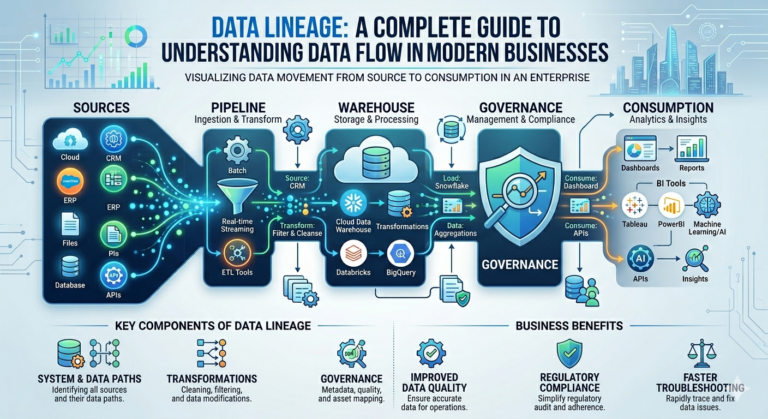
Data lineage is a concept that explains how data moves across different systems in an organization. It shows the complete journey of data from its origin to its final destination, including all transformations and processes.
In modern businesses, data is collected from multiple sources such as websites, applications, and databases. Understanding this flow helps companies maintain transparency, accuracy, and trust in their data.
Data lineage is important because it helps organizations make better and more reliable decisions based on verified data.
It also plays a major role in data governance and ensures that data processes are properly documented and controlled.
What is Data Lineage?
Data lineage refers to the process of tracking how data is created, processed, and used across different systems. It provides a clear map of the data lifecycle from start to end.
This includes understanding where data comes from, how it is modified, and where it finally gets stored or used.
Data lineage is often represented visually using diagrams or flowcharts to make complex data systems easier to understand.
It is widely used in analytics and business intelligence to ensure data accuracy and reliability.
Importance of Data Lineage in Modern Businesses
Data lineage is very important for modern businesses because it provides complete visibility into data flow. Companies can easily see how data is being used across systems.
It helps improve data quality by identifying errors or inconsistencies in the data pipeline. These issues can be quickly traced and fixed.
It is also important for legal and regulatory compliance, as many industries require proper documentation of data movement.
Overall, data lineage builds trust in data and supports better decision-making.
Data Sources in Data Lineage
Data sources are the starting point of the data journey. These are systems where raw data is collected or generated.
Common data sources include websites, mobile applications, CRM systems, APIs, and IoT devices.
Each source provides different types of data, such as user activity, transactions, or system logs.
Identifying data sources is the first and most important step in building a proper data lineage system.
Data Storage in Data Lineage
Data storage refers to systems where data is stored after collection and processing. These include databases, data warehouses, and data lakes.
Databases are used for structured data, while data lakes store large volumes of raw and unstructured data.
Data warehouses are mainly used for reporting and business intelligence purposes.
In data lineage, storage systems help track how data is saved, accessed, and reused over time.
Data Transformation Process
Data transformation is the process of converting raw data into a useful format. This includes cleaning, filtering, and organizing data.
During transformation, data often passes through multiple tools and systems. Each step improves data quality and usability.
It is important to track every transformation step to maintain accuracy in data lineage.
This helps organizations understand how final reports and dashboards are generated.
Data Flow and Movement
Data flow refers to how data moves from one system to another within an organization. It shows the complete path of data across systems.
This flow can be real-time or batch-based depending on business requirements.
Tracking data flow helps ensure consistency and reduces duplication of data.
A well-structured data flow improves system performance and reliability.
Benefits of Data Lineage
Data lineage offers many benefits for businesses. It provides full transparency of data movement across systems.
It improves decision-making by ensuring that data is accurate and trustworthy.
It also helps in faster troubleshooting by identifying the exact source of errors.
Additionally, it supports data governance and compliance with industry regulations.
Challenges of Data Lineage
One major challenge of data lineage is complexity, especially in large organizations with multiple systems.
Another challenge is maintaining accuracy as data constantly changes and grows over time.
Integration of different systems can also be difficult due to varying data formats and structures.
To overcome these challenges, organizations often use automated data lineage tools.
Tools Used for Data Lineage
Several tools are used to manage and track data lineage efficiently. These tools automate the process and reduce manual effort.
Popular tools include Apache Atlas, Informatica, and Talend
These tools provide visual maps of data flow, making it easier to understand complex systems.
They are widely used in enterprises for data governance and compliance purposes.
Conclusion
Data lineage is an essential part of modern data management. It provides complete visibility into how data is collected, processed, and used.
By understanding data sources, storage systems, transformation, and data flow, businesses can improve accuracy and trust in their data.
It also helps organizations meet compliance requirements and maintain high-quality data standards.
In today’s data-driven world, data lineage is not optional — it is a necessity for every modern business.