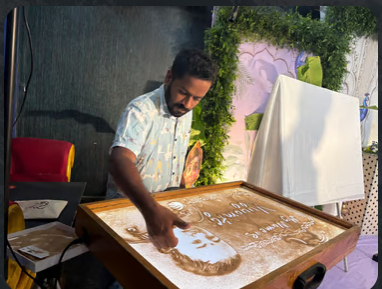
Renuka swamy hails from Honnebagi village in Chikkanayakanahalli taluk of Tumkur district. With a degree in fine arts, he embarked on a remarkable journey as a sand artist and art exhibitor. For over a decade, Renuka swamy has mesmerized audiences by showcasing his sand art at a wide array of corporate events.
Among his notable achievements is the creation of a captivating sand art portrayal of the life story of Chief Minister Siddaramaiah, which earned him personal appreciation from the CM himself. His talent has also been featured on popular reality shows aired on Colors Kannada, bringing his unique art form to a broader audience.
A sand artist is a visual storyteller who uses sand as their primary medium to create powerful, emotional, and often temporary works of art. With simple tools like their hands, fingers, and sometimes brushes or sticks, sand artists transform loose grains into detailed images that capture moments, messages, and memories. What makes sand art unique is not just the beauty of the final image, but the process itself—fluid, dynamic, and constantly evolving.
Sand art has ancient roots. Early civilizations used sand in rituals, floor designs, and symbolic drawings, particularly in cultures across Asia, Africa, and the Middle East. Over time, this traditional practice evolved into a modern performance art, gaining global popularity through stage shows, television talent programs, and digital media. Today, sand artists perform live in front of audiences, often accompanied by music or narration, creating images in real time that appear and disappear within minutes.
One of the most striking aspects of sand art is its impermanence. Unlike paintings or sculptures meant to last for decades, sand art is temporary by nature. An image may be wiped away moments after it is completed to make space for the next scene. This fleeting quality adds emotional depth to the performance, reminding viewers of the transient nature of life, time, and experiences. Many sand artists intentionally use this quality to tell stories about love, loss, hope, social issues, or historical events.
Modern sand artists often perform using illuminated glass tables. A camera placed above the table projects the artwork onto a large screen, allowing audiences to witness every movement of the artist’s hands. As the sand shifts and transforms, one image seamlessly morphs into another—faces become landscapes, symbols turn into scenes, and abstract shapes form meaningful visuals. This transformation is what captivates audiences and sets sand art apart from static visual art forms.
Sand artists create content for a wide range of purposes. Their performances are popular at cultural festivals, corporate events, weddings, and educational programs. Many brands and organizations collaborate with sand artists to visually communicate messages during product launches or awareness campaigns. In education, sand art is used as a creative storytelling tool to explain history, moral lessons, or social values in an engaging and memorable way.
In the digital age, sand artists also produce content for social media platforms such as YouTube, Instagram, and TikTok. Short sand art videos, time-lapse creations, and themed performances reach millions of viewers worldwide. These digital platforms have allowed sand artists to expand their audience beyond sandartlive performance and preserve their otherwise temporary art in recorded form.