In today’s fast-paced manufacturing landscape, achieving efficient, precise, and reliable metal joining is critical for OEMs, automation integrators, and industrial factories. Electric resistance welding (ERW) has emerged as a cornerstone technology for industries seeking high-quality welds with consistent performance. From automotive assembly to heavy machinery fabrication, ERW offers speed, repeatability, and cost-effectiveness that traditional welding methods cannot match.
At Heron Welder, we specialize in delivering advanced resistance welding machines, controllers, and automated production lines tailored to meet your manufacturing needs. In this article, we explore the principles, applications, and best practices of electric resistance welding while highlighting how Heron’s solutions empower modern factories.
What Is Electric Resistance Welding?
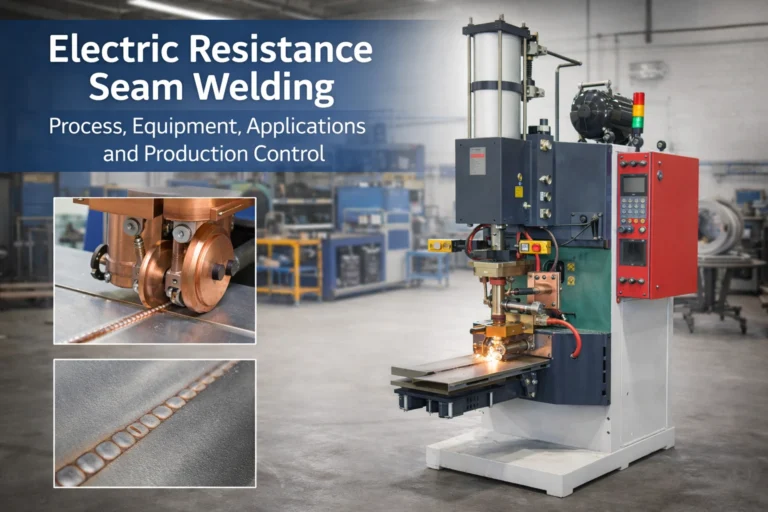
Electric resistance welding is a metal-joining process that generates heat through electrical resistance to fuse workpieces together. Unlike arc welding, ERW does not rely on filler materials or an open flame. Instead, it applies controlled electrical current and pressure at the joint, causing the metal to heat, soften, and bond.
The process can be categorized into several types, each optimized for specific applications:
- Spot welding: Ideal for sheet metals, commonly used in automotive and appliance manufacturing.
- Projection welding: Focuses current on raised projections, allowing simultaneous welds at multiple points.
- Seam welding: Produces continuous welds, perfect for tanks, pipes, and containers.
- MFDC (Medium Frequency Direct Current) welding: Provides precise energy control for thin or sensitive metals.
- Capacitor discharge welding: Delivers high-intensity, short-duration welds for small components.
How Electric Resistance Welding Works
ERW relies on the principle that electrical current passing through a conductor generates heat due to resistance. The steps in a typical ERW process include:
- Clamping – The workpieces are held firmly between electrodes to ensure consistent contact.
- Current Application – A controlled electrical current passes through the joint, heating the metal via resistance.
- Pressure Application – Mechanical pressure is applied to forge the molten metals together.
- Cooling – The weld cools under pressure, forming a strong metallurgical bond.
This combination of heat and pressure creates welds that are strong, uniform, and repeatable, making ERW highly suited for automated production environments.
Key Applications of Electric Resistance Welding
Electric resistance welding is used across industries that demand precision, speed, and reliability:
- Automotive manufacturing – Spot and seam welding dominate body-in-white (BIW) production, ensuring structural integrity and crashworthiness.
- Appliance fabrication – Household appliances like refrigerators, washing machines, and ovens rely on ERW for robust sheet-metal assembly.
- Aerospace and transportation – Lightweight metals and high-strength alloys are welded efficiently without compromising mechanical properties.
- Metal furniture and construction – Tubular structures, cabinets, and storage solutions benefit from strong, cost-effective welds.
Heron’s range of resistance welding machines, from spot welders to automated MFDC lines, is engineered to meet these diverse industrial demands.
Electric Resistance Welding vs. Other Welding Methods
Understanding the advantages of ERW compared to other welding techniques helps manufacturers make informed decisions:
| Welding Method | Key Advantage | Limitations |
|---|---|---|
| Electric Resistance Welding | High speed, repeatable, minimal filler, excellent for sheet metals | Requires precise equipment, limited thickness range |
| Arc Welding (MIG/TIG) | Versatile, suitable for thick materials | Slower, requires skilled operators, filler material needed |
| Laser Welding | Extremely precise, low heat input | High cost, requires specialized setup |
| Gas Welding | Portable, simple setup | Less consistent, slower, high heat affected zone |
For factories seeking automation-ready, high-throughput welding solutions, ERW often provides the optimal balance of speed, strength, and cost-efficiency.
Best Practices for Electric Resistance Welding
Optimizing ERW processes is essential for high-quality, defect-free welds. Key considerations include:
- Electrode Maintenance – Regular cleaning and reshaping prevent inconsistent welds and reduce downtime.
- Current Control – Calibrated welding parameters ensure proper heat generation and prevent material burn-through.
- Pressure Settings – Correct electrode pressure prevents weak joints or excessive deformation.
- Material Compatibility – Different metals (steel, aluminum, coated sheets) require tailored welding parameters.
- Automation Integration – Using Heron’s welding controllers and robotic solutions improves precision, repeatability, and productivity.
By combining advanced machinery with best practices, manufacturers can achieve consistent quality while reducing operational costs.
Why Choose Heron Welder for Electric Resistance Welding
At Heron Welder, we provide comprehensive solutions for industrial welding challenges:
- Full Range of ERW Machines – Spot, projection, seam, MFDC, and capacitor discharge welders designed for diverse applications.
- Automation-Ready Systems – Seamlessly integrate welding machines into robotic production lines.
- Advanced Controllers – Precision control over current, pressure, and timing ensures optimal weld quality.
- Global Support – Expert engineering support and service for factories worldwide.
Heron’s solutions are trusted by OEMs, manufacturers, and automation integrators seeking reliability, efficiency, and high-quality results.
Frequently Asked Questions (FAQs)
1. Can electric resistance welding join dissimilar metals?
Yes, ERW can join certain dissimilar metals, but parameters must be carefully adjusted to prevent weak joints or excessive heat damage.
2. What materials are best suited for ERW?
Steel, stainless steel, aluminum, and coated sheet metals are commonly used in ERW applications.
3. How does MFDC spot welding differ from conventional spot welding?
MFDC uses medium-frequency direct current for faster heating and precise control, making it ideal for thin metals or heat-sensitive materials.
4. Is ERW suitable for automated production lines?
Absolutely. ERW is highly compatible with robotics and automated welding cells, delivering consistent quality at high speed.
5. How do I optimize electrode life in ERW machines?
Regular cleaning, reshaping, and monitoring welding parameters help maximize electrode lifespan and reduce downtime.
Take Your Manufacturing to the Next Level
Electric resistance welding is a proven solution for factories that demand speed, precision, and repeatability. By partnering with Heron Welder, you gain access to advanced resistance welding machines, automated production lines, and expert engineering support tailored to your industry’s needs.
Contact Heron today to request a quote or consult with our specialists on custom welding and automation solutions designed to elevate your manufacturing efficiency and product quality.