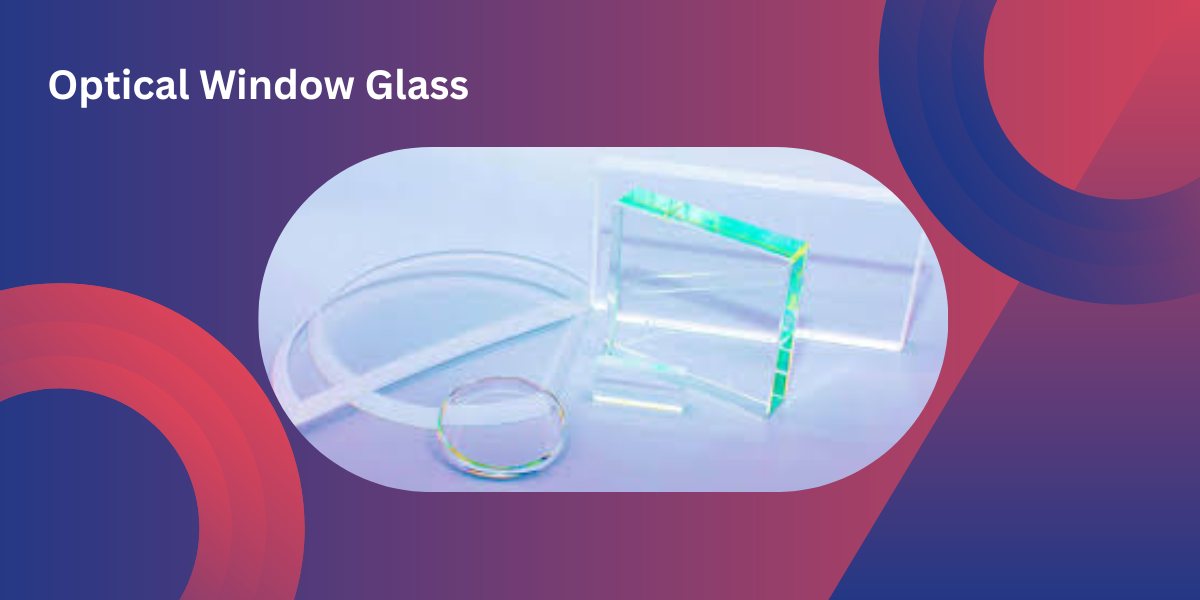
In the B2B optoelectronics sector, we often focus our R&D budgets on the “glamour” components: high-resolution sensors, GaAs lasers, and complex CMOS backplanes. However, a persistent failure point in industrial deployments isn’t the sensor itself—it’s the protective barrier between the technology and the environment.
For engineers designing outdoor LiDAR units, industrial inspection cameras, or aerospace sensors, the choice of window glass is often treated as an afterthought. Yet, using a sub-optimal transparent substrate can lead to signal attenuation, wavefront distortion, and catastrophic thermal failure.
The Problem: Why “Clear” Glass Isn’t Always Transparent
When you integrate a high-precision optical engine into a protective housing, the window glass acts as the first point of interaction for incoming signals. Standard soda-lime glass, while ubiquitous in architecture, presents three critical problems for B2B optoelectronic applications:
- Spectral Absorption: Conventional glass often has “absorption bands” in the Near-Infrared (NIR) or Short-Wave Infrared (SWIR) spectrums. For a LiDAR system or a thermal sensor, this translates to a massive drop in detection range and accuracy.
- Surface Parallelism and Wedge Error: If the two surfaces of the window glass are not perfectly parallel, the window acts as a prism. This shifts the beam path, causing alignment errors in laser-based measurement systems.
- Thermal Expansion Mismatch: In industrial environments, rapid temperature fluctuations can cause the glass to expand at a different rate than its metal housing. This leads to stress-induced birefringence, which alters the polarization of light and degrades image quality.
Engineering the Solution: Moving Beyond Soda-Lime
To maintain the integrity of a $10,000 sensor, the protective window glass must be engineered with the same precision as the internal lenses. For B2B providers, the transition from “hardware store” glass to “optical grade” substrates is a non-negotiable step for reliability.
1. The Shift to Borosilicate and Fused Silica
For applications requiring high thermal stability, Borosilicate glass (like Schott Borofloat®) is the industry standard. It offers a low coefficient of thermal expansion, ensuring that the window remains structurally sound from -50°C to over 400°C.
For even more demanding UV or IR applications, Fused Silica is the preferred choice. It provides exceptional transmission across a broad spectrum and is virtually free of the metallic impurities that cause “tinting” or absorption in cheaper glass.
2. Precision Surface Finishing
An expert-grade optical window must be specified with high surface quality (often 40-20 scratch-dig or better) and flatness (measured in fractions of a wavelength, such as $\lambda/4$). These specifications ensure that the incoming light wave remains coherent and undistorted as it passes through the glass.
Technical Enhancements: Functional Coatings
In the B2B space, the “glass” is rarely just glass. It is a substrate for advanced thin-film coatings that solve specific environmental problems.
- Anti-Reflective (AR) Coatings: Without AR coating, a standard piece of window glass reflects about 4% of light per surface. In a high-precision system, this 8% loss (and the resulting internal “ghost” reflections) can wash out a sensor’s dynamic range.
- Hydrophobic and Oleophobic Layers: For outdoor B2B hardware, such as security cameras or autonomous vehicle sensors, rain and oil buildup are major hurdles. Modern coatings ensure that water beads off instantly, maintaining a clear line of sight without mechanical wipers.
- EMI/RFI Shielding: In defense or medical environments, the window glass often needs to block electromagnetic interference. This is achieved by embedding a microscopic conductive mesh or an ITO (Indium Tin Oxide) coating onto the glass surface.
Semantic Keywords for Enhanced Indexability
To ensure this article ranks for B2B procurement and engineering searches, we must look at the broader semantic landscape. Search engines categorize “window glass” in this context through related technical terms:
- Optical Grade Substrates: Distinguishing the material from commercial construction glass.
- Refractive Index (nD): The critical measurement of how much the glass bends light.
- Transmission Efficiency: The percentage of light that successfully passes through the medium at specific wavelengths.
- Thermal Shock Resistance: The ability of the glass to withstand sudden temperature changes without fracturing.
By focusing on these “Expert-Level” terms, your content signals to search algorithms that you are providing a technical solution, not a consumer product.
Conclusion: The Window is the First Lens
In optoelectronics, the window glass is effectively the first lens of your system. Treating it as a simple mechanical cover is a recipe for degraded performance and field failures. By selecting high-purity substrates like Fused Silica or Borosilicate and applying application-specific coatings, B2B manufacturers can ensure their sensors perform at their theoretical limits, regardless of the environment.
The difference between a successful deployment and a “noisy” signal often comes down to the few millimeters of glass sitting in front of your sensor.