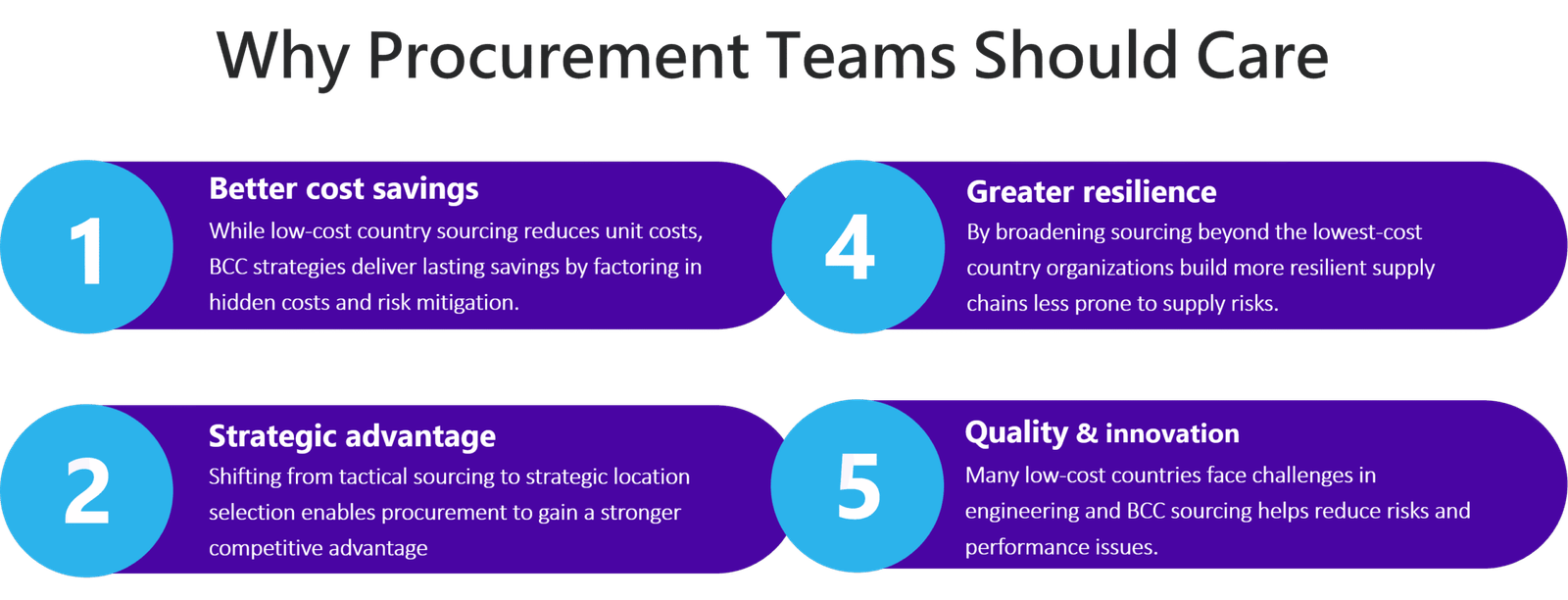
In today’s rapidly evolving global economy, companies can no longer rely solely on chasing the lowest production costs. For many years, organizations pursued low cost country sourcing as the primary procurement strategy—moving manufacturing and supplier contracts to countries offering the cheapest labor and materials. While this method often delivered short-term savings, it also introduced significant risks and hidden costs.
Long lead times, supply disruptions, quality issues, logistics complexities, and geopolitical uncertainty have revealed the limitations of focusing only on the lowest unit price. As global supply chains become more complex and volatile, businesses are shifting toward a more balanced and strategic approach known as Best Cost Country Sourcing.
This approach prioritizes long-term value, resilience, and operational efficiency rather than simply selecting the cheapest sourcing location.
What is Best Cost Country Sourcing?
Best Cost Country Sourcing is a procurement strategy that identifies the sourcing location offering the optimal combination of cost, supplier capability, quality standards, operational reliability, and risk management.
Instead of asking, “Which country offers the lowest price?”, procurement leaders ask a more strategic question: “Which location provides the best overall value for this category of goods or services?”
This model focuses heavily on Total Cost of Ownership (TCO), ensuring that all direct and indirect costs associated with sourcing are considered before making decisions. By taking a broader view of cost and risk, organizations can avoid expensive surprises that often arise when relying purely on low cost country sourcing.
Why Organizations Are Moving Beyond Low Cost Country Sourcing
The traditional low-cost sourcing model was built on the assumption that labor cost differences alone determined competitiveness. However, modern supply chains have exposed the weaknesses of that approach.
Several factors are pushing procurement teams toward Best Cost Country Sourcing, including:
- Rising labor costs in historically low-cost manufacturing hubs
- Global logistics disruptions and increasing freight costs
- Geopolitical tensions affecting international trade
- Stricter compliance and sustainability requirements
- Growing expectations for supply chain resilience
In many cases, the cheapest production location can actually become more expensive when logistics delays, quality failures, and inventory carrying costs are included.
This shift has also increased the demand for low cost country sourcing consultants who help organizations evaluate sourcing options using data-driven models and global market intelligence.
Core Pillars of a Best Cost Country Sourcing Strategy
A successful Best Cost Country Sourcing framework evaluates sourcing destinations across several critical dimensions.
1. Total Cost of Ownership (TCO)
Total Cost of Ownership is the foundation of a best cost sourcing strategy. It captures every cost involved in procuring and delivering a product.
Key cost components include:
- Labor and raw material expenses
- Energy and operational overhead
- Freight and transportation costs
- Import duties and tariffs
- Inventory storage and carrying costs
- Quality issues such as scrap, rework, or warranty claims
- After-sales service and support
For example, sourcing from a country with lower wages may initially appear cheaper. However, if longer transit times require higher inventory levels or if quality issues increase rework costs, the total cost may exceed that of sourcing from a more advanced manufacturing region.
2. Supplier Capability and Performance
Supplier reliability plays a major role in determining the best sourcing location. Procurement teams must evaluate suppliers based on performance metrics such as:
- Consistency of product quality
- Technical expertise and engineering support
- Production scalability and capacity
- Flexibility during demand fluctuations
- Lead time stability
- On-time delivery performance
In many cases, a supplier offering slightly higher pricing but superior technical capability and process control may provide far greater long-term value.
3. Country Risk and Economic Stability
Macroeconomic and geopolitical risks can significantly disrupt global supply chains. A well-structured Best Cost Country Sourcing strategy evaluates each location’s risk environment.
Key factors include:
- Political and regulatory stability
- Currency fluctuations
- Trade policies and tariff exposure
- Infrastructure quality (ports, roads, logistics systems)
- Ease of doing business
- Cultural compatibility and communication capability
The disruptions caused by the COVID-19 pandemic highlighted the danger of relying too heavily on a single region. As a result, many companies are diversifying their supplier base across multiple countries.
4. Strategic Business Alignment
Sourcing decisions must support broader business objectives. Procurement leaders should assess whether a sourcing location aligns with long-term company goals such as:
- Faster speed to market
- Innovation and product development collaboration
- Proximity to key customer markets
- Environmental, Social, and Governance (ESG) commitments
- Long-term expansion opportunities
Best Cost Country Sourcing is therefore not just a procurement exercise—it is a strategic decision that affects competitiveness and operational resilience.
Steps to Implement Best Cost Country Sourcing
Organizations can successfully implement this approach by following a structured process.
1. Define Category Requirements
Every procurement category has unique requirements. Companies must clearly define:
- Target cost objectives
- Quality standards and certifications
- Lead time expectations
- Innovation or engineering requirements
- Geographic limitations
- Sustainability criteria
Different product categories may require different sourcing geographies.
2. Evaluate Countries Using a Data-Driven Framework
A structured evaluation model allows procurement teams to compare sourcing destinations objectively. Important factors include:
- Labor and production costs
- Logistics and transportation expenses
- Trade agreements and tariffs
- Currency risk exposure
- Infrastructure quality
- Supply chain reliability
Working with low cost country sourcing consultants can help organizations analyze these variables using global market data and procurement analytics.
3. Identify and Assess Suppliers
Once promising locations are shortlisted, the next step is mapping the supplier ecosystem.
Procurement teams should evaluate:
- Supplier certifications and compliance levels
- Manufacturing capacity
- Financial stability
- Industry cluster maturity
- Backup supplier availability
Factory audits, product trials, and digital risk assessment tools help validate supplier capabilities.
4. Plan Transition and Governance
Transitioning sourcing locations requires careful planning to avoid operational disruptions.
Key activities include:
- Phased supplier onboarding
- Inventory buffer planning
- Logistics network adjustments
- Stakeholder communication
- Performance tracking and governance
Strong governance ensures the projected savings and operational benefits are achieved.
Importance of Best Cost Country Sourcing for Indian Procurement Teams
For procurement professionals in India, Best Cost Country Sourcing presents both opportunities and strategic considerations.
India is increasingly recognized as a competitive sourcing destination due to:
- A skilled and technically capable workforce
- Competitive manufacturing costs
- Rapidly improving infrastructure
- Strong English-language communication capability
At the same time, global buyers are also exploring other sourcing hubs such as Vietnam, Malaysia, and Eastern Europe to diversify supply chain risk. Many multinational organizations now adopt a “China + 1” strategy to balance cost efficiency with supply chain resilience.
Indian companies serving global markets must therefore continuously evaluate whether India remains the best cost sourcing location for each product category.
Related Blogs:-
A story of strategic discovery: How market intelligence services can help you grow
Market Intelligence Services: Your Compass in a Foggy Marketplace
Spend Data Classification: From a Messy Spreadsheet to a Strategic Goldmine
FAQs
1. What is Best Cost Country Sourcing?
Best Cost Country Sourcing is a procurement strategy that selects sourcing locations based on total value, including cost, supplier capability, quality, logistics, and risk factors rather than focusing solely on the lowest price.
2. How is Best Cost Country Sourcing different from low cost country sourcing?
Low cost country sourcing primarily focuses on the lowest labor or production cost, whereas Best Cost Country Sourcing considers the Total Cost of Ownership (TCO), including logistics, quality, risk, and long-term operational efficiency.
3. Why is Total Cost of Ownership important in sourcing decisions?
Total Cost of Ownership includes hidden expenses such as transportation, tariffs, inventory holding, quality issues, and compliance costs, giving organizations a more accurate understanding of the true sourcing cost.
4. How can low cost country sourcing consultants help businesses?
Low cost country sourcing consultants provide market intelligence, supplier identification, cost modeling, and risk analysis to help companies select the most efficient and strategic sourcing locations.
5. What industries benefit most from Best Cost Country Sourcing?
Industries such as manufacturing, automotive, electronics, consumer goods, and industrial equipment benefit significantly because they rely heavily on global supplier networks and complex supply chains.
Conclusion
The era of relying solely on low cost country sourcing is gradually coming to an end. Modern supply chains demand a more comprehensive and strategic sourcing model.
Best Cost Country Sourcing enables organizations to evaluate sourcing decisions based on total value, balancing cost efficiency with supplier capability, risk mitigation, and long-term business strategy.
By adopting a structured, data-driven sourcing framework and leveraging the expertise of low cost country sourcing consultants, procurement teams can build more resilient supply chains while maintaining sustainable cost advantages in an increasingly uncertain global market.
Contact our analytics experts to schedule a consultation and uncover how we can accelerate your journey of becoming a data-driven organization.