India’s alcohol industry is growing fast. The IMFL segment alone crossed 390 million cases in FY2023. New brands enter the market every quarter, and most of them rely on contract manufacturing to get off the ground. The model makes sense it avoids the capital cost of building a distillery. But choosing the wrong partner can stall your launch, damage your product quality, or expose you to compliance risk.
This post covers what contract manufacturing alcohol India actually involves, how to evaluate potential partners, what to watch out for in agreements, and how to protect your brand through production.
What Is Contract Manufacturing in the Alcohol Industry?
Contract manufacturing in the alcohol industry is an arrangement where a brand owner engages a licensed distillery or bottling unit to produce spirits or other alcohol products on their behalf. The brand owner supplies the formulation, label design, and quality specifications. The manufacturer handles production, bottling, and in some cases, excise compliance.
This model is common across IMFL categories whisky, rum, vodka, brandy, and ready-to-drink formats. It lets emerging brands reach the market without owning manufacturing infrastructure.
How Is It Different from Toll Manufacturing?
Toll manufacturing is a subset of contract manufacturing. In toll manufacturing, the brand owner supplies the raw materials including ENA or grain spirit and the facility charges only for processing. In standard contract manufacturing, the manufacturer sources raw materials and delivers a finished product. Brands with specific grain or spirit sourcing requirements often prefer toll manufacturing for tighter control over input quality.
What Licence Does a Contract Manufacturer Need?
A contract manufacturer in India must hold a valid distillery or bottling licence issued by the state excise authority where the unit is located. Some states also require a specific endorsement permitting third-party or contract production. The brand owner needs a separate licence typically a blending and bottling licence or a brand registration in each state where they intend to sell. Licence requirements vary significantly by state, so check with the relevant state excise department before finalising any manufacturing agreement.
What Product Categories Can Be Made Under Contract?
Most licensed contract facilities in India can produce whisky, rum, vodka, brandy, gin, and RTD (ready-to-drink) formats. Some also offer beer and wine production, though these require separate licence conditions. Craft and premium-segment brands often look for facilities with column distillation or pot still capacity, which is less common and commands higher fees.
How Do You Choose the Right Contract Manufacturer for Your Alcohol Brand?
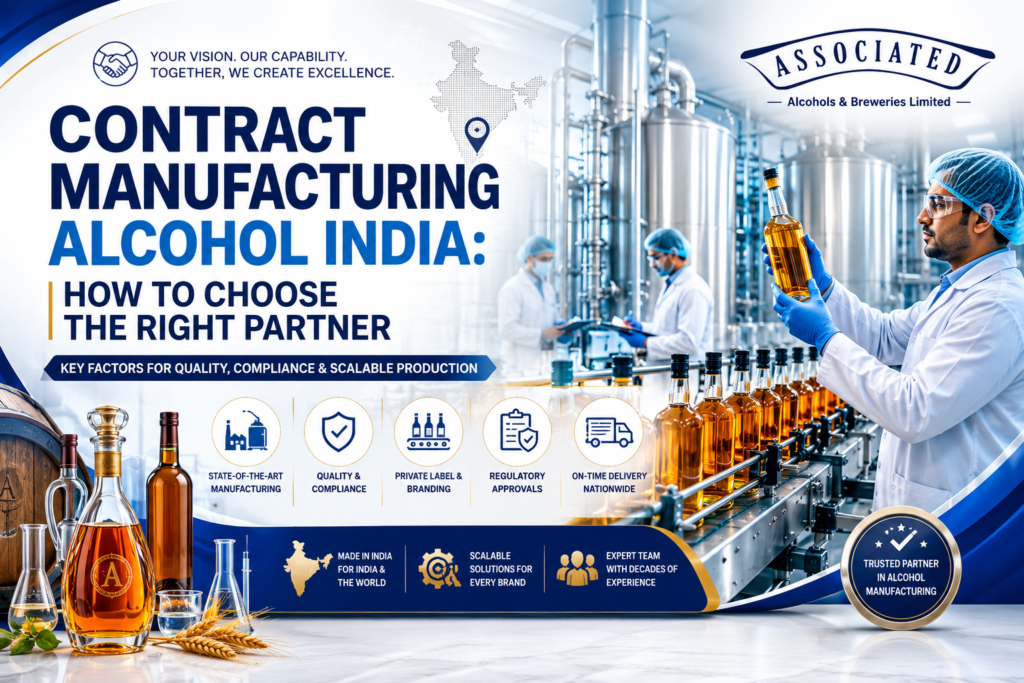
The right contract manufacturer for your alcohol brand is one that holds all required licences, has auditable quality systems, has proven capacity in your target product category, and can meet your cost-per-case targets without compromising on specification. Price should be the last filter, not the first.
Check Regulatory and Licensing Status First
Before any commercial discussion, verify that the manufacturer holds a current, valid state excise licence for contract production. Ask for documentary proof not verbal assurance. If the facility is in a state that restricts inter-state movement of alcohol, assess how that affects your distribution plans. A facility that cannot serve your priority markets is not the right partner, regardless of its production quality.
Evaluate Quality Control Infrastructure
Ask specifically about the quality control lab, testing protocols for ENA and finished product, and whether the facility follows GMP standards. Request a facility audit before signing any agreement. Look for documentation on batch consistency, rejection rates, and complaint handling. If a facility resists an audit, that is itself a red flag.
Independent labs that test for methanol levels, congener profiles, and label accuracy provide an additional layer of assurance. Some brands build third-party testing clauses directly into their manufacturing agreements.
Assess Production Capacity and Lead Times
Understand the facility’s current utilisation rate. A manufacturer running at 90% capacity will struggle to accommodate your surge requirements during peak season. Get written commitments on lead times for initial production runs, repeat orders, and rush requests. Also ask about minimum order quantities some facilities have high MOQs that may not suit a brand in the early launch phase.
For a detailed overview of what a capable contract manufacturing setup looks like in practice, this resource on
For a detailed overview of what a capable contract manufacturing setup looks like in practice, this resource on alcohol contract manufacturing in India covers the end-to-end production process across spirit categories.
What Are the Risks of Contract Manufacturing for Alcohol Brands?
The main risks in contract manufacturing for alcohol brands are quality inconsistency, IP exposure, compliance gaps, and overdependence on a single manufacturer. Each of these can be managed through contract terms, audits, and diversification but only if you identify them before production begins.
Quality Inconsistency Across Batches
Batch-to-batch variation is the most common complaint among brands that use contract manufacturers. It often comes from inconsistent ENA sourcing, changes in blending ratios, or operator-level variation on the production floor. Specify your product parameters in exact, measurable terms in the manufacturing agreement colour, aroma profile, ABV tolerance, and packaging standards. Do not leave room for interpretation.
IP and Formulation Protection
Your formulation is a commercial asset. Include explicit confidentiality clauses, IP ownership terms, and non-compete provisions in your agreement. Be cautious about sharing full formulation details with a manufacturer that also produces competing brands in your category. Some brand owners register their formulations as trade secrets before commencing contract production.
Compliance and Excise Risk
Excise compliance in India sits at the state level, and rules differ sharply across states. If your manufacturer files incorrect excise returns or misclassifies your product, you carry reputational and financial exposure even if the error originated with them. Build in contractual clauses that allocate compliance responsibility clearly and require the manufacturer to notify you immediately of any regulatory inspection or notice.
What Costs Are Involved in Alcohol Contract Manufacturing in India?
Contract manufacturing costs for alcohol brands in India typically include a per-case manufacturing fee, raw material charges (ENA, packaging), excise duty, and logistics. The manufacturing fee alone can range from ₹30 to ₹150 per case depending on product category, complexity, and facility tier.
Key Cost Components to Negotiate
- ENA cost and sourcing margin (ask for pass-through pricing with proof of purchase)
- Bottling line charges glass vs PET, bottle size, and label complexity all affect per-unit cost
- Minimum order quantity lower MOQs typically mean higher per-case costs
- Quality testing charges clarify whether lab costs are included or billed separately
- Storage and inventory holding fees relevant if your distribution pace is slower than production
Hidden Costs to Watch
Watch for charges related to formulation development, trial runs, and mould costs for proprietary bottle shapes. Some manufacturers also charge separately for excise liaison services. Get a full cost sheet in writing before signing the agreement.
Final Thoughts
Choosing the right partner for contract manufacturing alcohol in India is a strategic decision, not just a procurement exercise. The manufacturer you choose will shape your product quality, your compliance posture, and your ability to scale. Vet thoroughly, audit early, and document everything in the agreement.
As more brands enter the Indian alcohol market, the demand for high-quality contract manufacturing capacity will intensify. The brands that build strong manufacturing partnerships now will be better positioned to meet that competition and to protect what makes their product worth choosing.