
Personal injury claims after a car accident can feel overwhelming, especially when you are dealing with pain, insurance calls, and confusing legal terms.
If someone else caused your accident, you may be entitled to compensation for your injuries, lost earnings, and other expenses. However, the process involves strict time limits, evidence rules, and a government portal for smaller claims.
This guide explains exactly how personal injury claims work after a car accident in the UK, from the moment of the crash to receiving your compensation.
And if you are unsure where to start, a trusted Personal Injury Solicitor can offer a free initial consultation and advise whether your claim is worth pursuing on a No Win No Fee basis.
Who Can Make a Personal Injury Claim After a Car Accident?
You can claim if you were injured in an accident that was not your fault, or only partially your fault. You do not need to be the driver.
| Who Can Claim | Example |
| Driver (not at fault) | Hit from behind at a red light |
| Passenger | In a taxi or friend’s car involved in a crash |
| Cyclist | Hit by a car that failed to stop at a junction |
| Pedestrian | Struck by a car while crossing on a green light |
| Motorcyclist | Hit by a driver who changed lanes without checking |
What About Partial Fault?
If you were partly responsible (e.g., 20% at fault), you can still claim. Your compensation will be reduced by your percentage of fault. For example, a £10,000 claim with 20% fault = £8,000 payout.
The Personal Injury Claims Process – Step by Step
Here is what happens from the moment you decide to claim.
| Step | What Happens | Typical Timeline |
| 1 | Contact a solicitor for free assessment | Day 1–3 |
| 2 | Gather evidence (photos, witnesses, medical records) | Week 1 |
| 3 | Solicitor sends letter of claim to at-fault insurer | Week 2–3 |
| 4 | Insurer investigates and admits or denies liability | 1–3 months |
| 5 | Medical examination by independent expert | 2–4 months |
| 6 | Negotiation of compensation amount | 3–6 months |
| 7 | Settlement or court proceedings | 6–12 months (or longer) |
The Official Injury Claim Portal – For Claims Under £5,000
Since the Whiplash Reform Programme (2021), most road traffic accident claims worth £5,000 or less must go through the Official Injury Claim portal. You cannot go straight to court.
| Claim Value | Portal Required? | Legal Fees Recovered? |
| Under £5,000 (whiplash) | Yes | Limited |
| £5,001–£25,000 | Optional | Yes (standard costs) |
| Over £25,000 | No (court track) | Yes |
Whiplash Fixed Tariff (2026 Update)
Whiplash injuries now have fixed compensation amounts based on how long symptoms last.
| Duration of Whiplash Symptoms | Fixed Compensation (2026) |
| Up to 3 months | £240–£500 |
| 3–6 months | £500–£1,500 |
| 6–9 months | £1,500–£2,500 |
| 9–12 months | £2,500–£3,000 |
| 12–15 months | £3,000–£3,500 |
| 15–18 months | £3,500–£4,000 |
| Over 18 months | £4,000–£4,345+ (may exceed tariff) |
Evidence Checklist – What You Need to Prove Your Claim
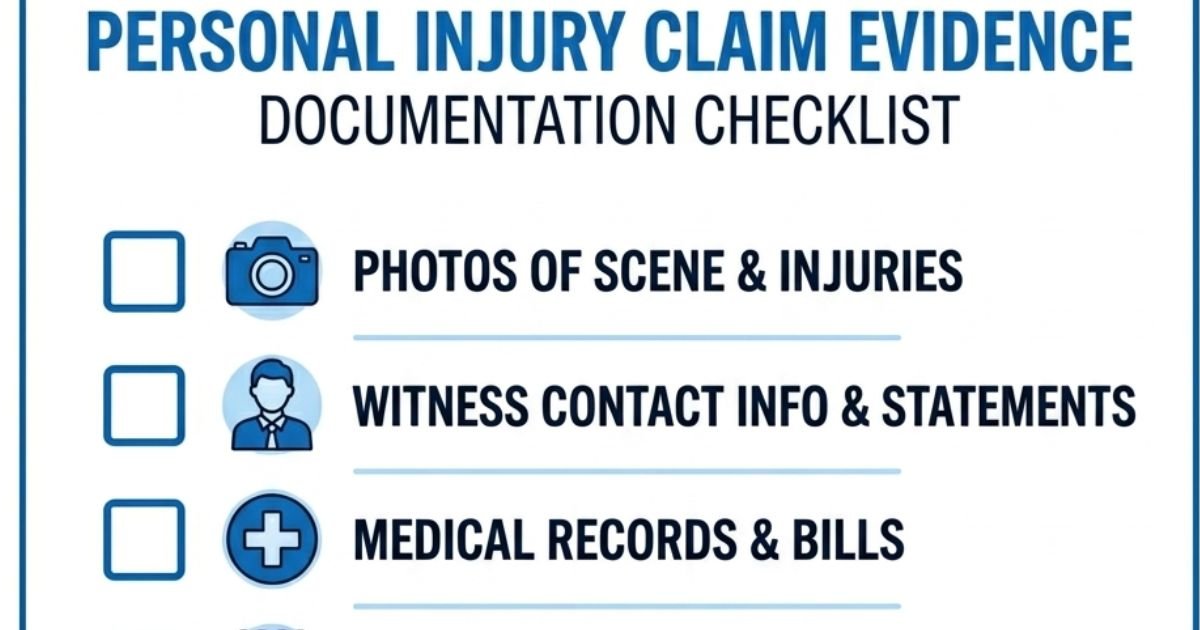
Strong evidence is the foundation of any successful personal injury claim.
| Evidence Type | What to Collect | Why It Matters |
| Photos | Vehicle damage, road conditions, injuries | Proves accident severity |
| Witness statements | Names, contacts, written accounts | Supports your version of events |
| Dashcam footage | Save original file, back up | Indisputable evidence |
| Police report | Incident number, attending officer | Official record |
| Medical records | A&E, GP, ambulance reports | Links injury to accident |
| Expense receipts | Travel, prescriptions, car hire | Proves financial losses |
| Symptom diary | Daily pain, sleep loss, activity limitations | Shows impact on life |
Real-World Case Study – The Diary That Won the Case
“A client was rear-ended on the M25. The other driver admitted fault at the scene but later changed his story. No dashcam. No witnesses. His solicitor advised him to keep a detailed diary of his symptoms – the neck pain, the sleepless nights, the inability to play with his children. That diary became key evidence when the other insurer tried to undervalue his claim. He settled for £8,500 – £3,000 more than the initial offer – largely because of his detailed diary.”
Compensation Table – What You Could Claim
Compensation is split into general damages (pain and suffering) and special damages (financial losses).
General Damages (Judicial College Guidelines 2026)
| Injury Type | Severity | Compensation Bracket |
| Whiplash (tariff) | Up to 18 months | £240–£4,345 |
| Back injury (soft tissue) | Moderate | £5,000–£15,000 |
| Back injury (disc herniation) | Severe | £15,000–£50,000 |
| Neck injury (soft tissue) | Moderate | £5,000–£15,000 |
| Fractured leg (simple) | Moderate | £10,000–£25,000 |
| Fractured leg (complex) | Severe | £25,000–£60,000 |
| PTSD | Moderate | £5,000–£20,000 |
| PTSD | Severe | £20,000–£60,000 |
| Brain injury (mild) | Moderate | £15,000–£45,000 |
| Brain injury (moderate) | Severe | £45,000–£150,000 |
Special Damages – Financial Losses
| Expense Type | Typical Amount | How to Prove |
| Loss of earnings | £100–£500+ per day | Payslips, employer letter |
| Private physiotherapy | £50–£100 per session | Receipts, invoices |
| Travel to hospital | £10–£50 per trip | Receipts, mileage log |
| Care from family | £10–£20 per hour | Diary, witness statements |
| Medication | Prescription costs | Pharmacy receipts |
Time Limits – The 3-Year Rule
Under the Limitation Act 1980, you generally have three years to start a personal injury claim.
| Situation | Time Limit |
| Accident date known | 3 years from accident date |
| Injury discovered later | 3 years from “date of knowledge” |
| Claimant under 18 | 3 years from 18th birthday |
| Claimant lacks mental capacity | No time limit (litigation friend acts) |
| Fatal accident | 3 years from death or knowledge |
Do not wait. Evidence fades, memories weaken, and witnesses disappear. Start your claim as soon as possible.
MIB Claims – If the Other Driver Is Uninsured or Untraced
If the at-fault driver has no insurance or fled the scene, you can claim through the Motor Insurers’ Bureau (MIB).
| Situation | MIB Scheme | Excess |
| Uninsured driver | MIB Uninsured Agreement | £300 |
| Hit-and-run (untraced) | MIB Untraced Drivers Agreement | £0 (if vehicle identified via ANPR) |
The process is similar to a standard claim but takes longer (6–18 months). A solicitor is highly recommended for MIB claims.
2026 Updates – What Has Changed
| Update | What It Means for You |
| Whiplash tariff updated | Small increase for longer-duration symptoms (6–18 months) |
| Portal claim limit proposed increase | From £5,000 to £10,000 for non-whiplash injuries |
| MIB digital portal launched | Faster processing for uninsured driver claims |
| Fixed recoverable costs extended | More cases subject to fixed legal fees (less negotiation) |
| Rehabilitation code updated | Stronger emphasis on early medical treatment |
No Win No Fee – How It Works
Most personal injury solicitors offer Conditional Fee Agreements (CFAs) – known as No Win No Fee.
| Scenario | You Pay |
| You lose the claim | £0 (no legal fees) |
| You win the claim | Success fee (up to 25% of compensation, capped by law) |
What is covered: Solicitor’s time, medical reports, court fees, barrister costs.
What you may pay separately: Disbursements if you lose (some solicitors offer insurance to cover this).
Always read your CFA carefully before signing. A reputable Personal Injury Solicitor will explain every term in plain English.
Conclusion:
Personal injury claims after a car accident do not have to be daunting. The process is structured, the time limits are clear, and the compensation framework is well established. But success depends on three things: acting quickly, gathering strong evidence, and getting expert legal advice.
| Priority | Action |
| Evidence | Photos, witnesses, dashcam, medical records |
| Medical care | See a GP or A&E immediately |
| Legal advice | Speak to a solicitor before speaking to the other insurer |
| Time limit | Do not wait – 3 years passes quickly |
| No Win No Fee | Most solicitors offer this – ask before signing |
If you have been injured in a car accident that was not your fault, do not let confusion or fear stop you from claiming what you are entitled to. A trusted Personal Injury Solicitor can assess your case, gather evidence, and negotiate with insurers on your behalf often with no upfront cost. Start your claim today and focus on what matters most: your recovery.
